
Professor Emeritus
School of Epidemiology and Public Health

Ronald Labonté PhD
Ronald Labonté is Professor Emeritus and former Distinguished Research Chair in Globalization and Health Equity in the School of Public Health and Epidemiology, University of Ottawa. His early public health work focused on health promotion, community empowerment, and social determinants of health, where much of his early writing, analyses, and practice models contributed to the foundational 1986 Ottawa Charter for Health Promotion. By the mid-1990s, while consulting with public health groups in dozens of countries in Europe, the Americas, and the Antipodes, he noted health workers’ ubiquitous concerns with cutbacks and retrenchments, drawing his attention to what, at global scale, might be driving so many nation states in a disequalizing direction. 1994 marked the birth of the World Trade Organization, and the instantiation of ‘structural adjustment programs’ at both the World Bank and International Monetary Fund. Since then much of his work has focused on the health equity impacts of global political economics and the analytical and advocacy efforts of activist civil society organizations.


Publications
Dr. Labonté has published over 400 peer-reviewed articles. Most of these are accessible on Researchgate or academia.edu; with recent (post-2010) articles with links posted on his CV posted on this site.
Projects
Dr. Ronald Labonté is a globally recognized leader in public health and Professor Emeritus at the University of Ottawa, having dedicated over 50 years to research and policy advocacy focused on globalization, health equity, and the social determinants of health.
Critical Public Health Public health has long been concerned with the distribution of disease in differing publics, and in the conditions that give rise to outbreaks, epidemics, and pandemics. There is also a history of calling on health and other public officials to intervene in what we now call the social (or societal, or socioenvironmental) determinants of health. But much public health reduces to an individual or risk factor level of analysis, which led to calls for more critical approaches to understanding population health and disease: in the 1970s to ‘radical community social medicine’ and ‘new public health,’ in the 1980s to ‘health promotion’ and ‘critical public health.’ As one of the publications suggests, the implications of a critical public health research or practice is two-fold: an obligation to uncover how specific social structures condition and constrain health opportunities, and a praxis based on community/civil society engagement and an activist commitment to social change (Critical Perspectives in Public Health, London: Routledge. 2007). In 1990, the journal Critical Public Health was launched, giving voice to a distinct form of public health activist research. Although still published, in 2023 the journal editorial board resigned to protest the publisher’s insistence on fewer article rejections and profit-maximization by adopting a fully open access (author-pay) publishing model. Critical public health scholarship continues in a variety of other platforms. Key Publications Books McLaren, L., Green, J., Labonté, R. New directions in critical public health: health in turbulent times London: Routledge (2025) https://www.routledge.com/New-Directions-in-Critical-Public-Health-Health-in-Turbulent-Times/McLaren-Green-Labonte/p/book/9781032354804 An update on some of the themes presented in the edited 2007 text (below), this book draws from, and supplements, some of the analyses of articles published in the Critical Public Journal before the mass resignation of editorial board members. Bourgeault, I., Labonté, R., Packer, C., and Runnels, V. (eds.) Population Health in Canada: Issues, Research & Action. (2018) Toronto: Canadian Scholars Press. https://canadianscholars.ca/book/population-health-in-canada/ This contributed volume includes papers from the Population Health Improvement Research Network (PHIRN) of Ontario and offers a focused analysis of the social and economic determinants of health that impact the health status of populations in Ontario as well as the conditions that can improve the health status of populations across Canada. The different sections address health policy theories, research methods, program interventions, and strategies for knowledge translation. Green, J. and Labonté, R. (eds). Critical Perspectives in Public Health, London: Routledge. 2007. https://www.researchgate.net/publication/291842378_Critical_Perspectives_in_Public_Health An early retrospective on critical public health scholarship, featuring many of its foundational elements. Publications and Presentations Labonté, R., ‘Public health can no longer fence-sit politically,’ Canadian Journal of Public Health online 22 October 2024 pp:1-4. https://doi.org/10.17269/s41997-024-00941-2 Labonté, R., Baum, F, and Sanders, D. “Poverty, Justice and Health,” in (eds.). Oxford Textbook of Public Health 7e, Oxford University Press, 2022. https://www.researchgate.net/publication/357022257_Poverty_justice_and_health Musolino, C., Baum, F., Freeman, T. Labonté, R., Bodini, C., Sanders, D., “Global health activists’ lessons on building social movements for Health for All” International Journal for Health Equity (2020) 19:116, pp.1-14. https://rdcu.be/b5s7f Bodini, C., Baum, F., Labonté, R., Legge, D., Sanders, D. Sengupta, A. “Methodological challenges in research activism in action: civil society engagement towards health for all,” Critical Public Health (2020) 30(4): 386-97. https://doi.org/10.1080/09581596.2019.1650892 Khayatzadeh-Mahani, A., Ruckert, A., & Labonté, R. “Obesity prevention: co-framing for intersectoral ‘buy-in’”, Critical Public Health (2017) 28(1):4-11. [http://www.tandfonline.com/eprint/5fQJNT8PA8qmzdVDXfI7/full Torres, D., Balcazar, H., Rosenthal, L., Labonté, R., Fox, D. & Chiu, Y. “Community health workers in Canada and the U.S.: Working from the margins to address health equity,” Critical Public Health (2017) 27(5):533-540. 1-8. http://www.tandfonline.com/doi/full/10.1080/09581596.2016.1275523 Macdonald, J., Raphael, D., Labonté, R., Colman, R., Torgerson, R. and Hayward, K. “Income and health in Canada: Canadian researchers' conceptualizations make policy change unlikely”, International Journal of Health Services 39(3): 525-43. 2009. https://www.researchgate.net/publication/26829305_Income_and_Health_in_Canada_Canadian_Researchers'_Conceptualizations_Make_Policy_Change_Unlikely Raphael, D., Labonté, R., Colman, R., Hayward, K. Torgerson, R., Macdonald, J. “Income and Health in Canada: Research gaps and future opportunities”, Canadian Journal of Public Health 97 (Supp. 3): S16-S23. 2006. https://www.researchgate.net/publication/6448734_Income_and_health_in_Canada_Research_gaps_and_future_opportunities Labonté, R. “Editorial: Towards a critical population health research”, Critical Public Health 15(1):1-3. 2005. https://www.researchgate.net/publication/263249072_Editorial_Towards_a_critical_population_health_research Labonté, R., Polanyi, M., Muhajarine, N., McIntosh, T. and Williams, A. “Beyond the divides: A critical population health project”, Critical Public Health 15(1):5-17. 2005. https://www.researchgate.net/publication/239314920_Beyond_the_divides_Towards_critical_population_health_research Labonté, R. "The population health/health promotion debate in Canada: the politics of explanation, economics and action", Critical Public Health 7(1&2): 7-27. 1997. https://www.researchgate.net/publication/233129816_The_population_healthhealth_promotion_debate_in_Canada_the_politics_of_explanation_economics_and_action
Global Health Development Development theories and development assistance have been fixtures on the global health landscape for decades, most recently with adoption of the 2015 Sustainable Development Goals (SDGs). Considerable controversies continue to surround health development assistance, including the complex forms it takes (vertical, diagonal, horizontal), the lack of consistency over time, disbursements driven by donor interests rather than need, high transaction costs of poor donor coordination, a ‘charity’ rather than ‘entitlement’ approach, the rise of global philanthropies, and the lack of coherence between donors’ aid and their international trade/macroeconomic policies. In recent years, the role of micro-financing has been advanced as a key development strategy, although it remains controversial; and ‘social impact investing’ (where private investors finance projects with global social/public good outcomes, but also with the expectation of profit) is inserting a market logic into previously humanitarian notions of assistance or obligation. In this context, most recently dramatically affected by the 2025 US slashing of foreign aid, emulated by many other donor countries, the SDGs still resonate as important global health targets. While pressured by increasing health care privatizations, the aims of comprehensive primary health care still drive much public health research and advocacy. And bridging the development and primary health care nexus is the longstanding global emphasis on improving maternal/child health outcomes. New tab: Sustainable Development Goals Publications and Presentations Hussain, S., Javadi, D., Andrey, J., Ghaffar, A., and Labonté, R. “Health intersectoralism in the Sustainable Development Goal era: from theory to practice,” Globalization and Health (2020) 16;15: 1-5. https://globalizationandhealth.biomedcentral.com/articles/10.1186/s12992-020-0543-1 Bergen, N., Ruckert, A., Labonté, R. “Monitoring frameworks for Universal Health Coverage in the Sustainable Development Goals: What about high-income countries?” International Journal of Health Policy and Management (2019) 1-7. https://www.ijhpm.com/article_3612.html Proulx, K, Ruckert, A., and Labonté, R. “Canada’s Flagship Development Priority: Maternal, Newborn and Child Health (MNCH) and the Sustainable Development Goals (SDGs)” Canadian Journal of Development Studies /Revue canadienne d’études du développement. (2017) 38(1):39-53. http://www.tandfonline.com/doi/full/10.1080/02255189.2016.1202103 Labonté, R. “Development goals in the post-2015 world: Whither Canada?” Canadian Journal of Public Health 2014, 105(3):e224-e228. New tab: Primary Health Care A global political movement for Primary Health Care (PHC) emerged from the historic 1978 Alma Ata Conference on Primary Health Care. PHC focused especially on community and primary-level health care, outlining a strategy to provide more equitable, appropriate, and effective basic health care while incorporating actions to address the underlying social, economic, and political causes of poor health, what is now referred to as social, political and commercial determinants of health. Importantly, the Alma Ata document insisted that PHC was unlikely to succeed without the establishment of a New International Economic Order (NIEO) that would ensure: the rights of states and peoples under ‘colonial domination’ to restitution and full compensation for their exploitation and that of their resources; regulation of transnational corporations; preferential treatment for developing countries in all areas of international economic cooperation; transfer of new technologies; and an end to the waste of natural resources. With the rise of neoliberal economics in the 1980s, however, the UN-supported NIEO experienced a scarcely noted death. But efforts to build more comprehensive PHC systems continued throughout the 1990s and 2000s, many of which formed the basis of international comparative studies, or more granular national and local research used to inform and advocate for enabling fiscal and related public policies. Book Labonté, R., Packer, C., Sanders, D. and Schaay, N. (eds.) Revitalizing Health for All: Case Studies in the Struggle for Comprehensive Primary Health Care (2017) University of Toronto Press. https://idrc-crdi.ca/en/books/revitalizing-health-all-case-studies-struggle-comprehensive-primary-health-care This book draws together a number of case studies from A multi-year study (2007 – 2014) focusing on comprehensive reform struggles within low- and middle-income countries. Publications and Presentations Freeman, T., Baum, F., Labonté, R., Javanparast, S., Lawless, A., and Barton, E. “The contribution of group work to the goals of comprehensive primary health care.” Health Promotion Journal of Australia (2021) 32, 126-36. https://onlinelibrary.wiley.com/doi/abs/10.1002/hpja.323 Gabriela Cuevas Barron, George Laryea-Adjei, Vaira Vike-Freiberga, Ibrahim Abubakar, Henia Dakkak, Delanjathan Devakumar, Anders Johnsson, Selma Karabey, Ronald Labonté, Helena Legido-Quigley, Peter Lloyd-Sherlock, Isaac Iyinoluwa Olufadewa, Harold Calvin Ray, Irwin Redlener, Karen Redlener, Ismail Serageldin, Nisia Trindade Lima, Virgilio Viana, Katherine Zappone, Uyen Kim Huynh, Nicole Schlosberg, Hanlu Sun, Ozge Karadag, “Safeguarding people living in vulnerable conditions in the COVID-19 era through universal health coverage and social protection,” Lancet Public Health 2021, pp.1-7. https://www.thelancet.com/journals/lanpub/article/PIIS2468-2667(21)00235-8/fulltext#%20 Sanders, D., Nandi, S., Labonté, R., Vance, C., Van Damme, W. “From primary health care to universal health coverage – one step forward and two steps back,” Lancet (2019) 394:619-21. https://www.researchgate.net/publication/335340568_From_primary_health_care_to_universal_health_coverage-one_step_forward_and_two_steps_back Javanparast, S., Freeman, T., Baum, F., Labonté, R., Ziersch, A., Mackean, T., Reed, R., Sanders, D., “How institutional forces, ideas and actors shaped population health planning in Australian regional primary health care organisations,” BMC Public Health (2018):1-16. http://rdcu.be/Jv49 Baum, F., Freeman, T., Lawless, A., Labonté, R., Sanders, D. "What’s the difference between comprehensive and selective primary health care? Evidence from a five year longitudinal realist case study in South Australia" BMJ Open (2017): e015271. http://bmjopen.bmj.com/content/bmjopen/7/4/e015271.full.pdf Javanparast, S., Maddern, J., Baum, F., Freeman, T., Lawless, A., Labonté, R., Sanders, D. “Change management in an environment of ongoing primary health care system reform: A case study of Australian primary health care services,” International Journal of Health Planning and Management, (2017) 1-13. http://onlinelibrary.wiley.com/doi/10.1002/hpm.2413/epdf Najafizada, S.A., Labonté, R., and Bourgeault, I. “Stakeholder’s perspective: Sustainability of a community health worker program in Afghanistan,” Evaluation and Planning (2017) 60:123-9. DOI: 10.1016/j.evalprogplan.2016.11.004 Baum, F., Freeman, T., Sanders, D., Labonté, R., Lawless, A., Javanparast, S. “Comprehensive Primary Health Care under neo-liberalism in Australia” Social Science and Medicine. 168 (2016) 43-52 http://dx.doi.org/10.1016/j.socscimed.2016.09.005 Freeman, T., Baum, F., Labonté, R., Javanparast, S., Lawless, A., “Primary health care reform, dilemmatic space, and risk of burnout among health workers,” Health. (2017) 22(3):277-97. http://journals.sagepub.com/doi/abs/10.1177/1363459317693404 Labonté, R., Sanders, D, Packer, C. and Schaay, N. “Is the Alma Ata Vision of Comprehensive Primary Health Care Viable? Findings from an International Project" Global Health Action 2014, 7(1):1-16. https://www.ncbi.nlm.nih.gov/pmc/articles/PMC4141965/pdf/GHA-7-24997.pdf Torres, D., Labonté, R., Spitzer, D., Andrews, C., Amaratunga, C. “Improving Health Equity: The Promising Role of Community Health Workers in Canada.” Healthcare Policy/Politiques de Santé 2014. 10(1):71-83. https://www.researchgate.net/publication/266375144_Improving_Health_Equity_The_Promising_Role_of_Community_Health_Workers_in_Canada Mosquera, P., Hernández ,J., Vega R., Labonté R., Sanders D., Dahlblom, K. and San Sebastián M. “Challenges of implementing a Primary Health Care strategy in Bogota, Colombia: A qualitative study,” International Journal of Health Planning and Management, 2013, DOI 10.1002/hpm.2228. https://www.researchgate.net/publication/258767827_Challenges_of_implementing_a_primary_health_care_strategy_in_a_context_of_a_market-oriented_health_care_system_The_experience_of_Bogota_Colombia Torres, S., Spitzer, D., Labonté R., Amaratunga, C. and Andrew, C. “Community Health Workers in Canada: Innovative approaches to health promotion outreach and community development among immigrant and refugee populations,” Journal of Ambulatory Care Management 2013, 36(4):305-18. https://www.researchgate.net/publication/259629831_Community_Health_Workers_in_Canada_Innovative_Approaches_to_Health_Promotion_Outreach_and_Community_Development_Among_Immigrant_and_Refugee_Populations Baum, F., Legge, D., Freeman, T. Lawless, A., Labonté, R., and Jolley, G. “The potential for multi-disciplinary primary health care services to take action on the social determinants of health: actions and constraints,” BMC Public Health 2013, 13:460, 1-13. https://link.springer.com/article/10.1186/1471-2458-13-460 Mosquera, P., Hernández J., Vega R., Martínez J., Labonté R. Sanders D. San Sebastián M., “Primary health care contribution to improve health outcomes in Bogota-Colombia: a longitudinal ecological analysis,” BMC Family Practice, 2012. DOI: 10.1186/1471-2296-13-84. https://link.springer.com/article/10.1186/1471-2296-13-84 Labonté, R., Sanders, D., Baum, F. et al “Implementation, Effectiveness and Political Context of Comprehensive Primary Health Care: Preliminary Findings of a Global Literature Review,” Australian Journal of Primary Health 14(3): 58-67, 2008. https://www.researchgate.net/publication/263005551_Implementation_Effectiveness_and_Political_Context_of_Comprehensive_Primary_Health_Care_Preliminary_Findings_of_a_Global_Literature_Review New tab: Safe Motherhood This IDRC funded multi year study (2015-2020), an outgrowth of our earlier comprehensive primary health care comparative research, focused on the four main health system barriers to safer motherhood, focusing on the Jimma Zone on the Oromia region of Ethiopia: socio-cultural, facility, communication, and transportation. Publications and Presentations: Mamo, A., Abera, M., Abebe, L., Bergen, N., Asfaw, S., Bulcha, G., Asefa, Y., Erko, E., Bedru, K., Lakew, M., Kurji, J., Kulkarni, M., Labonté, R., Birhanu, Z., Morankar, S., “Maternal social support and health facility delivery in Southwest Ethiopia,” Archives of Public Health, 2022; 80 (135), pp.1-14. [IF:3.260] https://archpublichealth.biomedcentral.com/articles/10.1186/s13690-022-00890-7 Bergen, N., Mamo, A., Morankar, S., Castel, N., Kulkarni, M., Labonté, R., “Capture it on video: Implementing a novel knowledge translation strategy as part of the Safe Motherhood Project, Jimma Zone, Ethiopia,” African Journal of Reproductive Health June 2021; 25 (3s):135-41. https://www.academia.edu/121939619/Capture_it_on_video_Implementing_a_novel_knowledge_translation_strategy_as_part_of_the_Safe_Motherhood_Project_Jimma_Zone_Ethiopia Bergen, N., Ruckert, A., Abebe, L., Asfaw, S., Kiros, G., Mamo, A., Morankar, S., Kulkarni, M., Labonté, R. “Characterizing ‘health equity’ as a national health sector priority for maternal, newborn, and child health in Ethiopia” Global Health Action (2021)14(1):1-11 https://www.tandfonline.com/doi/full/10.1080/16549716.2020.1853386 Bergen, N., Zhu, G., Asfaw, S., Mamo, A., Morankar, S., Labonté, R. “Promoting gender equity in health: challenges and opportunities in rural Ethiopia,” Global Health Action (2020) 13(1):1-15 https://www.tandfonline.com/doi/full/10.1080/16549716.2019.1704530 Kurji, J., Kulkarni, M. Gebretsadik, L., Wordofa, M., Sudhalar, M., Bedru, K., Bulcha, G., Thavorn, K., Labonté R., Taljaard, M. (2019) “Effectiveness of Upgraded Maternity Waiting Homes and Local Leader Training in Improving Institutional Births among Women in Jimma Zone, Ethiopia: study protocol for a cluster randomized controlled trial.” Trials 20(671): 1-11. https://www.ncbi.nlm.nih.gov/pmc/articles/PMC6894194/ Kurji, J., Talbot, B., Bulcha, G., Bedru, K., Sudhakar, M., Gebretsadik, L., Wordofa, M., Welch, V., Labonté R., Kulkarni, M. “Uncovering spatial variation in maternal healthcare service use at subnational level in Jimma Zone, Ethiopia,” BMC Health Services Research (2020) pp.1-14. https://doi.org/10.1186/s12913-020-05572-0 Bergen, N., Ruckert, A., Kulkarni, N., Abebe, L., Morankar, S., Labonté, R. “Subnational health management and the advancement of health equity: a case study of Ethiopia,” Global Health Research and Policy (2019) 4(12):1-13. https://rdcu.be/bCRAO Bergen, N., Labonté, R. “Everything is perfect, and we have no problems: detecting and limiting social desirability bias in qualitative research” Qualitative Health Research (2019) pp.1-10. https://www.researchgate.net/publication/337933377_Everything_Is_Perfect_and_We_Have_No_Problems_Detecting_and_Limiting_Social_Desirability_Bias_in_Qualitative_Research Bergen, N., Hudani, A. ,Asfaw, S., Mamo, A., Kiros, G., Kurji, J., Morankar, S., Abebe, L., Kulkarni, M., Labonté, R., “Promoting and delivering antenatal care in rural Jimma Zone, Ethiopia: Midwives’ perceptions of strengths, weaknesses, and interaction with Health Extension Workers to promote safe motherhood,” BMC Health Services Research (2019) 19:719 pp.1-9 https://rdcu.be/b8Kr7 Bergen, N., Abebe, L., Asfaw, S., Kiros, G., Kulkarni, M., Morankar, S., & Labonté, R. “Maternity waiting areas – serving all women? Barriers and enablers of an equity-oriented maternal health intervention in Jimma Zone, Ethiopia”, Global Public Health (2019) 14(10): 1509-1523, https://www.researchgate.net/publication/331993409_Maternity_waiting_areas_-_serving_all_women_Barriers_and_enablers_of_an_equity-oriented_maternal_health_intervention_in_Jimma_Zone_Ethiopia Nicole Bergen; Abebe Mamo; Shifera Asfaw; Lakew Abebe; Jaameeta Kurji; Getachew Kiros; Muluemebet Abera; Gebeyehu Bulcha Duguma; Kunuz Haji Bedru; Manisha A Kulkarni; Ronald Labonté; Sudhakar Morankar, “Perceptions and experiences related to health and health inequality among rural communities in Jimma Zone, Ethiopia: a rapid qualitative assessment,” International Journal of Health Equity (2018) 17:84 pp: 1-7. https://rdcu.be/0inx Najafizada, S.A., Bourgeault, I., and Labonté, R. “Social Determinants of Maternal Health in Afghanistan: a Review,” Central Asian Journal of Public Health (University of Pittsburgh) 6(1):1-26. DOI 10.5195/cajgh.2017.240 http://cajgh.pitt.edu/ojs/index.php/cajgh/article/view/240/240 New tab: Related Publications Yaya, S., Yeboah, H., Charles, C.H., Out, A., Labonté, R., (2020) “Ethnic and racial disparities in covid-19-related deaths: counting the trees, hiding the forest,” BMJ Global Health (2020) 5:1-5. ] https://gh.bmj.com/content/bmjgh/5/6/e002913.full.pdf Out, A. Ebenso, B., Labonté, R., Yaya, S. (2020) “Tackling COVID-19: can the African continent play the long game?” Journal of Global Health 10(1):1-5. http://jogha.org/documents/issue202001/jogh-10-010339.pdf Stoebenau K, Nair RC, Rambeloson V, Rakotoarison PG, Razafintsalama V, Labonté R, “Consuming sex: the association between modern goods, lifestyles and sexual behaviour among youth in Madagascar,” Globalization and Health 2013, 9:13 https://link.springer.com/article/10.1186/1744-8603-9-13 Schrecker, T. and Labonté, R. “Global development and population health”, in J. Nriagu. (ed.). Encyclopedia of Environmental Health, Revised Open Access Edition, Amsterdam: Elsevier. 2013. https://www.researchgate.net/publication/260095186_Global_Development_and_Population_Health

Global Health Diplomacy Since the 1990s health has risen as an international policy concern for many states. For some (the donor nations) it is an aspect of their foreign aid, which could have multiple goals ranging from the 1970 UN General Assembly resolution that developed countries allocate 0.7% of their gross national income to development assistance, to exerting ‘soft power’ influence over nations with which it which it wishes to trade or invest. With the eight Millennium Development Goals adopted by the UN in 2000, and the more extensive seventeen Sustainable Development Goals similarly adopted in 2015, health as a foreign policy issue gained increasing prominence in the diplomatic affairs of many nations. As two key publications in this section argue, there are several differing frames by which health can enter foreign policy discourse: as security, development, global public goods, trade, human rights and ethical/moral reasoning (Labonté 2008; Labonté and Gagnon 2010). Each frame has implications for how global health as a foreign policy issue is conceptualized. Differing arguments within and between these policy frames, while overlapping, can also be contradictory. Research on this theme involved theory and concept development, and historic and comparative country case studies (2015-2021) on how health is conceptualized (if at all) in countries’ foreign policies or evident in their international actions. Key Publications Publications and Presentations Khazatzadeh-Mahani, A., Ruckert, A. and Labonté, R., “Global Health Diplomacy,” in McInnes, C., Lee, K., and Yourde, J. The Oxford Handbook of Global Health Politics, New York: Oxford University Press, 2018. pp.1-23. http://www.oxfordhandbooks.com/view/10.1093/oxfordhb/9780190456818.001.0001/oxfordhb-9780190456818-e-7 Ruckert, R., Labonté, R., Lencucha, R., Runnels, V., and Gagnon, M., “Global health diplomacy: A critical review of the literature,” Social Science and Medicine 155 (2016): 61-72. https://www.researchgate.net/publication/297755778_Global_health_diplomacy_A_critical_review_of_the_literature Labonté, R., “Health in All (Foreign) Policies: Challenges in Achieving Coherence,” Health Promotion International 2014, 29:S1: 1-11. http://heapro.oxfordjournals.org/content/29/suppl_1/i48.full.pdf+html Labonté, R. and Gagnon, M. “Framing Health and Foreign Policy: Lessons for Global Health Diplomacy” Globalization and Health 6:14:1-22, 2010. https://link.springer.com/article/10.1186/1744-8603-6-14 Labonté, R. “Global Health in Public Policy: Finding the Right Frame?” Critical Public Health 18(4);467-482, 2008. https://www.tandfonline.com/doi/abs/10.1080/09581590802443588 Labonté, R. “Human Rights and Equity: The Value Base for Global Health Diplomacy,” in Kickbusch, I. et al. (eds.) Global Health Diplomacy: Concepts, Issues, Actors, Instruments, Fora and Cases, Springer Books. 2013. Pp. 89-106. Gagnon, M., and Labonté, R. “Human Rights in Global Health Diplomacy: A Critical Assessment.” Journal of Human Rights, 10(2): 189-213, 2011. Human Rights in Global Health Diplomacy: A Critical Assessment https://www.researchgate.net/publication/233057117_Human_Rights_in_Global_Health_Diplomacy_A_Critical_Assessment Lencucha, R., Kothari, A. and Labonté, R. “The Role of Non-Governmental Organizations in Global Health Diplomacy: Negotiating the Framework Convention on Tobacco Control”, Health Policy and Planning 2010:1-8. https://www.researchgate.net/publication/47679054_The_role_of_non-governmental_organizations_in_global_health_diplomacy_Negotiating_the_Framework_Convention_on_Tobacco_Control New tab: Comparative case studies Publications and Presentations Guerra, G., Orozco, E., Jimenes, P., Ruckert, A., Labonté, R., Salgado de Snyder, N., “Global Health Diplomacy in Mexico: Insights from key actors in the field,” Globalization and Health 2021 (137:1-11) https://globalizationandhealth.biomedcentral.com/articles/10.1186/s12992-021-00789-y Ruckert, A. Almeida, C, Ramirez, J, Guerra, G, Salgado de Snyder, N, Orozco, E, Alvarenga, A, de Sabaoya, AN, dos Santos RM, Sepulveda-Viveros, D, Vivian, E, da Silva Santos, M, Doriabni, K, Labonté R., “Global Health Diplomacy (GHD) and the Integration of Health into Foreign Policy: Towards a Conceptual Approach” Global Public Health (2021) 17(6): 1041-1054. https://www.tandfonline.com/doi/full/10.1080/17441692.2021.1900318 Ruckert, A. Almeida, C, Ramirez, J, Guerra, G, Salgado de Snyder, N, Orozco, E, Alvarenga, A, de Sabaoya, AN, dos Santos RM, Sepulveda-Viveros, D, Vivian, E, da Silva Santos, M, Doriabni, K, Labonté R., “Global Health Diplomacy (GHD) and the Integration of Health into Foreign Policy: Towards a Conceptual Approach” Global Public Health (2021) 17(6): 1041-1054. https://www.tandfonline.com/doi/full/10.1080/17441692.2021.1900318 Ruckert, A., Labonté, R., Lencucha, R. “Health in Canadian foreign policy: the role of norms and security interests,” Canadian Foreign Policy Journal (2019) pp. 1-18 https://www.tandfonline.com/doi/full/10.1080/11926422.2019.1642216 Jorge Ramirez, Leonel Valdivia, Elena Rivera, Marilia Santos, Dino Sepúlveda, Ronald Labonté, Arne Ruckert, “Chile's Role in Global Health Diplomacy: A Narrative Literature Review,” Globalization and Health (2018) 14:108:1-13. https://rdcu.be/bbLeS Ruckert, A., Labonté, R., Lencucha, R., Runnels, V., and Gagnon, M. “Dilomacia da Saude Global: um a revisao critica da literatura,” in Buss, P. & Tobar, S. (eds), Diplomacia em Saude e Saude Global: Perspectivas Latino-Americanas, Rio de Janeiro: Editoria Fiocruz, 2017, pp.143-162. Gagnon M. and Labonté, R. “Understanding how and why health is integrated into foreign policy: a case study of Health is Global: A UK Government Strategy 2008-2013” Globalization and Health 9:24. 2013 https://link.springer.com/article/10.1186/1744-8603-9-24 Runnels, V., Labonté, R. and Ruckert, A. “Global health diplomacy: Barriers to inserting health into Canadian foreign policy.” Global Public Health 2014:1-13. http://dx.doi.org/10.1080/17441692.2014.928740 Labonté, R., Runnels, V. and Gagnon, M., “Past Fame, Present Frames and Future Flagship? An Exploration of How Health is Positioned in Canadian Foreign Policy,” Adm. Sci. 2012, 2, 162-185; https://www.mdpi.com/2076-3387/2/2/162
Global Health Governance Global governance processes concern the agreed upon actions and means adopted by social actors to promote collective action and deliver solutions in pursuit of common goals. In distinction to government processes, such actions are not always backed by formal authority structures and usually involve actors beyond the nation state, including many private sector entities and various nongovernmental organizations (NGOs) and wider civil society groups. Academic and policy attention has gone into studying how to strengthen ‘global health governance’, the need for which is a result of a funding chokehold on the WHO, which has king been surpassed in financial standings by the health programs of the World Bank, the Bill and Melinda Gates Foundation (the WHO’s number one funder) and other philanthropies, and the growing number of ‘global health partnerships’, many of them structured as public-private-partnerships. A useful distinction is made between global health governance (where the focus is on health organizations and systems, much of it related to disease control), global governance for health (where non-health institutions policies or actions are interrogated for their impacts on health, addressing social/societal determinants of health), and governance for global health (see the global health diplomacy page, how health becomes a foreign policy concern). The COVID-19 pandemic generated considerable study of global health governance. One of the key systems of health governance are human rights, of which there 9 core human rights treaties. These treaties have legally binding obligations and duties under international law, although enforcement of these rights is relatively weak. The major means of holding governments to account are intermittent reports they must present to UN Human Rights Council, where fear of being ‘named and shamed’ for slow progress in realizing rights’ obligations could incentivize countries to strengthen their own legal systems’ instantiation of these obligations. Doing so can allow individuals or groups to pursue domestic legal remedies if they believe their human rights have been impugned. Key Publications Publications and Presentations Thow, A.M., Jones, A., Schneider, C.H. Labonté, R. “Increasing the public health voice in global decision-making on nutrition labelling,” Globalization and Health (2020) 16:3, pp.1-6. https://doi.org/10.1186/s12992-019-0533-3 Townsend, B., Friel, S., Freeman, T., Schram, A., Strazdins, L., Labonté, R., Mackean, T., Baum, F. “Advancing a health equity agenda across multiple policy domains: a qualitative policy analysis of social, trade, and welfare policy” BMJ Open (2020) 10(11):1-9. https://bmjopen.bmj.com/content/10/11/e040180 Labonté, R, Baum, F., “Right wing politics and public policy: the need for a broad frame and further research,” International Journal of Health Policy and Management (2020) p.1-4. https://www.ijhpm.com/article_3867_8d69ed606b8d967bae48b2917f68495f.pdf Ruckert, A., Fafard, P., Hindmarch, S., Morris, A., Packer, C., Patrick, D., Wesse, S., Wilson, K., Wong, A., and Labonté, R. (2020) “Governing Antimicrobial Resistance: A Scoping Review of Global Governance Mechanisms,” Journal of Public Health Policy (2020) pp.1-14. https://doi.org/10.1057/s41271-020-00248-9 Anne Marie Thow, Alexandra Jones, Carmen Huckel Schneider, Ronald Labonté, “Global governance of front of pack nutrition labelling: a qualitative analysis,” Nutrients (2019) 11(2), 268;1-14. https://doi.org/10.3390/nu11020268 Sanders, D., Labonté, R, Legge D., “Managing the conflicts between private interests and public responsibility,” BMJ Opinion, Feb.8 2018. http://blogs.bmj.com/bmj/2018/02/08/managing-the-conflicts-between-private-interests-and-public-responsibility/ Khayatzadeh-Mahani, Ruckert, A., & Labonté, R. “Could the WHO’s Framework on Engagement with Non-State Actors (FENSA) be a Threat to Tackling Childhood Obesity?” Global Public Health (2018) 13(9):1337-40. http://www.tandfonline.com/doi/full/10.1080/17441692.2017.1342852 Ruckert, A., Labonté, R. “Public-private partnerships (PPPs) in global health: the good, the bad and the ugly,” Third World Quarterly 2014, 35(9): 1598-1614. https://www.tandfonline.com/doi/full/10.1080/01436597.2014.970870#d1e149 Labonté, R. and Schrecker, T. “Foreign Policy Matters: A Normative View of the G8 and Population Health”, Bulletin of the World Health Organization 85:185-91. 2007. https://www.researchgate.net/publication/6345612_Foreign_Policy_Matters_A_Normative_View_of_the_G8_and_Population_Health New tab: The COVID-19 pandemic Publications and Presentations: Brisbois, B., Plamondon, K., Walugembe, D., Pereira, R. C., Edet, C., Dixon, J., Habibi, R., Karamouzian, K, Labonté, R., Murthy, S., Ravitsky, V. (2024). “Pandemics, intellectual property and ‘our economy’: A worldview analysis of Canada’s role in compromising global access to COVID-19 vaccines.” Global Public Health, 19(1). https://doi-org.proxy.bib.uottawa.ca/10.1080/17441692.2024.2335360 Baum. F., Flavel, J., Musolino, C., Paremoer, L. Labonté, R, “Can the world become a place where the planet and all people flourish after the pandemic?” BMJ (2022) 377:1-5. https://www.bmj.com/content/377/bmj-2021-067872 Packer, C., Halabi, S., Hollmeyer, H., Mithani, S., Wilson, L., Ruckert, A., Labonté R., Fidler, D., Gostin, L., Wilson K. “A survey of International Health Regulations National Focal Points experiences in carrying out their functions,” Globalization and Health (2021) 17:24: 1-9. https://globalizationandhealth.biomedcentral.com/track/pdf/10.1186/s12992-021-00675-7.pdf Wilson, K., Halabi, S., Hollmeyer, H., Gostin, L., Fidler, D., Packer, C., Wilson, L., Labonté R., “Strengthening National Focal Points ability to implement the International Health Regulations,” Bulletin of the World Health Organization (2021) 99(7):536-38. doi: http://dx.doi.org/10.2471/BLT.20.270116 Labonté, R., Wiktorowicz, M., Packer, C., Ruckert, A., Wilson, K., Halabi, S., “A Pandemic Treaty, Revised International Health Regulations, or Both?” Globalization and Health 2021 (128:1-4) https://globalizationandhealth.biomedcentral.com/articles/10.1186/s12992-021-00779-0 New tab: Human rights Publications and Presentations Labonté, R. “Trade and investment liberalization vs. human rights: Conflicts, compromises or a clear victor?” in R. Labonté, A. Ruckert & C. Packer (eds.), Special Section on “Trade, Health and Human Rights”, Canadian Yearbook of Human Rights (Vol 2, 2017), 2019, Ottawa: Human Rights Research and Education Centre, pp. 121-126. https://cdp-hrc.uottawa.ca/sites/cdp-hrc.uottawa.ca/files/uottawa-cyhr1618-v11.pdf McNamara, C. & Labonté, R. “Trade agreements, human rights and health in the context of labour markets and environmental standards” in R. Labonté, A. Ruckert & C. Packer (eds.), Special Section on “Trade, Health and Human Rights”, Canadian Yearbook of Human Rights (Vol 2, 2017), 2019, Ottawa: Human Rights Research and Education Centre, pp. 155-164. (50%) https://cdp-hrc.uottawa.ca/sites/cdp-hrc.uottawa.ca/files/uottawa-cyhr1618-v11.pdf Lencucha, R., Drope, J. Packer, C. & Labonté, R. “Tobacco, trade and the right to health” in R. Labonté, A. Ruckert & C. Packer (eds.), Special Section on “Trade, Health and Human Rights”, Canadian Yearbook of Human Rights (Vol 2, 2017), 2019, Ottawa: Human Rights Research and Education Centre, pp. 175-180. (30%) https://cdp-hrc.uottawa.ca/sites/cdp-hrc.uottawa.ca/files/uottawa-cyhr1618-v11.pdf Schrecker, T., Chapman, A., Labonté, R. and De Vogli, R. “Health and Human Rights Against the Marketplace: A Response to Reubi.” Social Sciences and Medicine, 73(5): 629-631, 2011. https://www.researchgate.net/publication/51555107_Health_and_human_rights_against_the_marketplace_A_response_to_Reubi Gagnon, M., Labonté, R., “Human Rights in Global Health Diplomacy: A Critical Assessment” Journal of Human Rights 10(2):189-213, 2011. https://www.researchgate.net/publication/233057117_Human_Rights_in_Global_Health_Diplomacy_A_Critical_Assessment Schrecker, T., Chapman, A., Labonté, R. and De Vogli, R. “Advancing health equity in the global marketplace: How human rights can help”, Social Science & Medicine 71(2010): 1520-26. https://www.academia.edu/764843/Advancing_Health_Equity_in_the_Global_Marketplace_How_Human_Rights_Can_Help?hb-sb-sw=171456
Global Health Mobilities In broad terms global health mobilities refers to the movement of peoples, primarily cross-border movement but increasingly also internal displacement, often due to conflict or environmental conditions such as drought. Research on this theme fell into two broad categories: health worker migration, where the health equity issue is the loss of (often publicly trained) skilled health workers from underserved poorer countries to better-served wealthy ones (‘brain drain’); and ‘medical tourism’, a quixotic term coined to describe the commercialization of international patients with the lure of recovery in touristic surroundings where the health equity concern is investment and growth of private care for international private paying patients crowding out access for poorer locals to less well equipped tax-funded public facilities. The health worker migration studies began when there was a surge of active recruitment for foreign-trained doctors and nurses in the Canadian provinces in which I worked; or were suggested by research colleagues in countries where I had migration studies as the obvious obverse of the outmigration of health professionals. Key Publications Books Labonté, R., Packer, C., Klassen, N. et al The Brain Drain of Health Professionals from Sub-Saharan Africa to Canada: Some Findings and Policy Options, Queens University: South African Migration Project. 2007. https://www.researchgate.net/publication/398095648_African_Migration_Development_Series_No Labonté, R., Deonandan, R., Packer, C., Runnels, V. (eds) Travelling Well: Essays in Medical Tourism, Ottawa: Collection d’études transdisciplinaires en santé des populations/Transdisciplinary Studies in Population Health Series, 4(1) 2013. ISSN 1922-1398. https://globalhealthequity.ca/archived-projects/medical-tourism/travelling-well-essays-in-medical-tourism/ Publications and Presentations New tab: Migration of Health Workers Walton-Roberts, M., Runnels, V., Sebastian, I.R., Sood, A., Naikr, S., Thomas, P., Packer, C., Labonté, R., Bourgreault, I., “Sending State Perspectives on the Global Migration of Indian Nurses,” International Migration, 2025; pp1-11. https://onlinelibrary.wiley.com/doi/epdf/10.1111/imig.70062 Tahzib, F., Davidovich, N., Labonté, R. “Migration, justice and health: Imagining the earth as one country and humankind its citizens,” Public Health (2019) 172:105-7. 10.1016/j.puhe.2019.03.016 Walton-Roberts, M., Runnels, V., Rajan, I., Sood, A., Nair, S., Thomas, P., Packer, C., MacKenzie, A., Tomblin-Murphy, G., Labonté, R., Bourgeault, I., “Causes, consequences and policy responses to the migration of health workers: Key findings from India,” Human Resources for Health (2017) 1-18. https://human-resources-health.biomedcentral.com/articles/10.1186/s12960-017-0199-y Castro-Palaganas, E., Spitzer, D., Kabamalan, M.M., Sanchez, M., Carcativo, R., Runnels, V., Labonté, R., Tomblin-Murphy, G., Bourgeault, I., “An examination of the causes, consequences, and policy responses to the migration of highly trained health personnel from the Philippines: the high cost of living/leaving—a mixed method study,” Human Resources for Health (2017) 15(25):1-14. https://human-resources-health.biomedcentral.com/articles/10.1186/s12960-017-0198-z Walton-Roberts, M., Runnels, V., Rajan, I., Sood, A., Nair, S., Thomas, P., Packer, C., MacKenzie, A., Tomblin-Murphy, G., Labonté, R., Bourgeault, I., “Causes, consequences and policy responses to the migration of health workers: Key findings from India,” Human Resources for Health (2017) 1-18. https://human-resources-health.biomedcentral.com/articles/10.1186/s12960-017-0199-y Bourgeault, I., Labonté, R., Runnels, V., Packer C. and Tomblin Murphy, G. “Knowledge and potential impact of the WHO Global Code of Practice on the International Recruitment of Health Personnel: Does it matter for source and destination country stakeholders?” Human Resources for Health (2016) 14:S1:1-3. https://link.springer.com/article/10.1186/s12960-016-0128-5 Tomblin Murphy, G., MacKenzie, A., Waysome, B., Guy-Walker, J., Palmer, R., Rose, A.E., Rigby, J., Bourgeault, I., and Labonté, R. “A mixed-methods study of health worker migration from Jamaica,” Human Resources for Health (2016) 14:S1:1-15. http://human-resources-health.biomedcentral.com/articles/10.1186/s12960-016-0125-8 Ly, B.A., Labonté, R., Bourgeault, I., Niang, M.N., “The Individual and Contextual Determinants of the Use of Telemedicine: a descriptive study of the perceptions of Senegal’s physicians and telemedicine projects managers,” PLOS One (2017) 1-18. https://doi.org/10.1371/journal.pone.0181070 Labonté, R., Sanders, D., Mathole, T., Crush, J., Chikanda, A., Dambisya, Y., Runnels, V., Packer, C., MacKenzie, A., Tomblin-Murphy, G. and Bourgeault, I. “Health worker migration from South Africa: Causes, consequences and policy responses,” Human Resources for Health (2015) 13:92:1-16. http://human-resources-health.biomedcentral.com/articles/10.1186/s12960-015-0093-4 Runnels, V., Labonté, R. and Packer, C. “Reflections on the Ethics of Recruiting Foreign-Trained Health Human Resources” Human Resources for Health. 9(2):1-11, 2011. https://link.springer.com/article/10.1186/1478-4491-9-2 Labonté, R., Packer, C., and Klassen, N. “Managing health professional migration from sub-Saharan Africa to Canada: a stakeholder inquiry into policy options.” Human Resources for Health, 4(22): 1478-1491, 2006. https://link.springer.com/article/10.1186/1478-4491-4-22 New tab: Medical Tourism Crooks, V., Labonté, R., Ceron, A., Johnston, R., Snyder, J., Snyder, M. ““Medical tourism will…obligate physicians to elevate their level so that they can compete”: a qualitative exploration of the anticipated impacts of inbound medical tourism on health human resources in Guatemala,” Health Human Resources (2019) 17(53):1-11. https://rdcu.be/bJ8n6 A. Cerón, A., Crooks, V., Labonté, R., Snyder, J., Flores, W. “Medical tourism in Guatemala: qualitatively exploring how existing health system inequities facilitate sector development,” International Journal of Health Services (2019) pp.1-19. https://doi.10.1177/0020731419866085 Crooks, V., Labonté, R. “Re: the upside of trade in health services,” BMJ June 29, 2019, https://www.bmj.com/content/365/bmj.l2208/rapid-responses Labonté, R., Crooks, V., Ceron, A., Runnels, V., and Snyder, J. “Government roles in regulating medical tourism: evidence from Guatemala,” International Journal for Equity in Health (2018) 17:150 pp.1-10 https://doi.org/10.1186/s12939-018-0866-1 Labonté, R., Runnels, V., Crooks, V., Johnston, R. & Snyder, J. “What does the development of medical tourism in Barbados hold for health equity? An exploratory qualitative case study,” Global Health Research and Policy (2017) 2(5):1-9. DOI 10.1186/s41256-017-0025-z; http://rdcu.be/pqtd Crooks, V., Johnston, R. Labonté, R, Snyder, J. “Critically reflecting on Loh’s “Trends and structural shifts in health tourism”” Science and Medicine (2016) 152:186-0. https://www.researchgate.net/publication/284228518_Critically_reflecting_on_Loh's_Trends_and_structural_shifts_in_health_tourism Snyder, J., Crooks, V., Johnston, R., Ceron, A., Snyder, J., Crooks, V., Johnston, R., Ceron, A., Labonté, R., “‘That's enough patients for everyone!’: Local stakeholders' views on attracting patients into Barbados and Guatemala's emerging medical tourism sectors,” Globalization and Health (2016) 12(60):1-13 https://link.springer.com/article/10.1186/s12992-016-0203-7 Johnston, R., Crooks, V., Ceron, A., Labonté, R., Snyder, J., Nunez, E., Flores, W., “Inbound Medical Tourism in Central America and the Caribbean: Factors Driving and Inhibiting Sector Development and Their Health Equity Implications,” Global Health Action (2016) 12(9):1-10. http://dx.doi.org/10.3402/gha.v9.32760 An Overview of Guatemala’s Medical Tourism Industry. Cerón, A., W. Flores, V.A. Crooks, R. Labonté, and J. Snyder. (2014). Department of Geography, Simon Fraser University. http://tinyurl.com/ousk4fh An Overview of Mexico’s Medical Tourism Industry. Núñez, E.O., Arias, R.M.B., Martínez, M.E.A., Larios, J.A.R., Crooks, V.A. Labonte, R., Snyder, J. and Nigenda, G. (2014). Department of Geography, Simon Fraser University. http://tinyurl.com/og9ds48 An Overview of the Medical Tourism Industry in Bangalore, India. Saligram, P.S., A. Bhattacharjee, V.A. Crooks, R. Labonté, A. Schram, and J. Snyder. (2014). Department of Geography, Simon Fraser University. http://tinyurl.com/pauqvsk An Overview of the Medical Tourism Industry in Chennai, India. Suresh, V. Madha, V.A. Crooks, R. Labonté, A. Schram, R. Kalaivani, S. Nithya, and J. Snyder. (2014). Department of Geography, Simon Fraser University. http://tinyurl.com/oy9uxnj Runnels, V., Labonté, R., Packer, C., Chaudhry, S., Adams, O., and Blackmer, J. “Canadian physicians' responses to cross border healthcare: a preliminary survey,” Globalization and Health 2014, 10(20):1-7. https://link.springer.com/article/10.1186/1744-8603-10-20 An Overview of Barbados’ Medical Tourism Industry. Johnston, R., V.A. Crooks, J. Snyder, H. Fraser, R. Labonté, and K. Adams. (2013). Department of Geography, Simon Fraser University. http://tinyurl.com/ns2gzns Alsharif, MJ., Labonté, R. and Zuxun, L. “Patients beyond borders: A study of medical tourists in four countries,” Global Social Policy, 10(3): 315-335, 2011. http://gsp.sagepub.com/content/10/3/315.full.pdf Runnels, V., Labonté, R., Packer, C., Chaudhry, S., Adams, O., & Blackmer, J. (2014). Canadian physicians’ responses to cross border health care. Globalization and Health. Vol. 10 (20); e1-e7. https://link.springer.com/article/10.1186/1744-8603-10-20 Hopkins, L., Labonté, R., Runnels, V. and Packer, C. “Medical tourism today: what’s the state of existing knowledge?” Journal of Public Health Policy 31:185-98, 2010. https://www.researchgate.net/publication/44660694_Medical_Tourism_Today_What_Is_the_State_of_Existing_Knowledge
Global Trade An increasingly interconnected and interdependent global economy and the dynamic nature of trade across borders have important implications for health everywhere. Economic policies for the past four decades have largely embodied neoliberal agendas that are subject to increasing empirical, ethical, and theoretical scrutiny, with widely accepted concerns over their impact on inequality, poverty, and environmental damage. Economic integration and trade and investment liberalization are defining features of contemporary globalization, first creating, and now revamping, global supply chains, creating both health opportunities and risks. How trade and investment treaties impact health outcomes within and between countries continues to be politically and empirically debated. The World Trade Organization, established in 1995, has been the major intergovernmental body overseeing multiple agreements that are binding on member states, one of the best known and studied ones being the TRIPS agreement that protects intellectual property rights, mostly held by wealthy corporations in the USA and Europe, and a source of contention during the COVID-19 pandemic. Outside of the WTO system, regional trade treaties have proliferated to overcome governance gridlock within the WTO system. Bilateral or regional investment treaties (as part of regional trade treaties) grant special rights to foreign investors to sue governments for actions perceived to affect the value of their investment (such as direct expropriation or passage of new laws and regulations considered ‘tantamount to expropriation’). These treaties similarly exploded in number, dispute frequency, and the size of monetary claims. Most pf these investor state disputes involve extractive industries (mining, fossil fuels) suing governments for introducing environmental protection policies. As one of the key publications on trade and health notes, the breadth and depth of these post-1995 trade and investment treaties meant that few areas of general public health concern are untouched (Gleeson and Labonté 2020). The re-election of Donald Trump to his second presidency in 2025 and his chaotic imposition of tariffs, as another key publication outlines, is re-shaping global trade in unexpected ways; although global trade will continue and, while slowing, is not demonstrably diminishing (Labonté et al 2025). Key Publications Books Gleeson, D., and Labonté, R., Trade Agreements and Public Health: A Primer for Health Policy Makers, Researchers and Advocates, London: Palgrave, 2020. (note: a private use download book is available here: https://www.researchgate.net/publication/338359112_Trade_Agreements_and_Public_Health_A_Primer_for_Health_Policy_Makers_Researchers_and_Advocates) Publications and Presentations NEW GLAH EDITORIAL TO BE ADDED Gleeson, D., Lexchin, J., Tenni, B., & Labonté, R. (2025). An opportunity to remove harmful intellectual property provisions from the Comprehensive and Progressive Agreement for Trans-Pacific Partnership. Health Economics, Policy and Law, 1-8. https://doi.org/10.1017/S1744133125100261 Barlow, P., Gleeson, D., O’Brien, P., Labonté, R., “Under the influence: is the World Trade Organization a forum for industry influence over global alcohol policies? A qualitative analysis of alcohol health warnings, 2010-2019,” Lancet Global Health 2022 (online) pp.1-9.. https://authors.elsevier.com/sd/article/S2214-109X(21)00570-2 Barlow, P., Gleeson, D., O’Brien, P., Labonté, R., “Under the influence: is the World Trade Organization a forum for industry influence over global alcohol policies? A qualitative analysis of alcohol health warnings, 2010-2019,” Lancet Global Health 2022 (online) pp.1-9.. https://authors.elsevier.com/sd/article/S2214-109X(21)00570-2 McNamara, C., Labonté, R., Schram, A., Townsend, B. “Glossary on Free Trade Agreements and Health: Part 1” Journal of Epidemiology and Community Health (2021) 75:402–406. https://jech.bmj.com/content/75/4/402 McNamara, C., Labonté, R., Schram, A., Townsend, B. “Glossary on Free Trade Agreements and Health: Part 2” Journal of Epidemiology and Community Health (2021) 75:407-412. https://jech.bmj.com/content/jech/75/4/407.full.pdf Townsend, B., Friel, S., Schram, A., Baum, F., Labonté, R. “What Generates Attention to Health in Trade Policymaking? Lessons from Success in Tobacco Control and Access to Medicines: A qualitative study of Australia and the (Comprehensive and Progressive) Trans Pacific Partnership,” International Journal of Health Policy and Management (2020) p.1-12 https://www.ijhpm.com/article_3821.html Labonté, R, Gleeson, D., McNamara, C. (2020) “USMCA 2.0: A few improvements but far from a ‘healthy’ treaty,” Globalization and Health 16(43):1-4. [IF:10.8] https://globalizationandhealth.biomedcentral.com/track/pdf/10.1186/s12992-020-00565-4 Townsend, B., Schram, A., Baum, F., Labonté, R., and Friel, S. “How does policy framing enable or constrain inclusion of the social determinants of health and health equity on trade policy agendas?” Critical Public Health (2020) 30(1):115-126. https://doi.org/10.1080/09581596.2018.1509059 Townsend, B., Schram, A., Labonté, R., Baum, F., Friel, S. “How do actors with asymmetrical power assert authority in policy agenda-setting? A study of authority claims by health actors in trade policy,” Social Science and Medicine (2019) 236: 1-9. https://authors.elsevier.com/c/1ZRv3-CmUlXyn Barlow, P., Labonté, R., McKee, M. and Stuckler, D., “WHO response to WTO member state challenges on tobacco, food and beverage policies,” Bulletin of World Health Organization 2019;97:846-48 https://www.who.int/bulletin/volumes/97/12/19-231985.pdf?ua=1 Baker, P., Friel, S., Gleeson, D., Thow, A-M., Labonté, R., “Trade and nutrition policy coherence: a framing analysis and Australian case study,” Public Health Nutrition (2019) pp.1-9. https://www.cambridge.org/core/journals/public-health-nutrition/article/trade-and-nutrition-policy-coherence-a-framing-analysis-and-australian-case-study/C53342339184AD8A2F2B362E7DF415DD Labonté, R., Crosbie, E., Gleeson, D., & McNamara, C. “USMCA (NAFTA 2.0): Tightening the constraints on the right to regulate for public health,” Globalization and Health (2019) 15:35, 1-15.https://rdcu.be/bCn0u Gleeson, D., Lexchinm J., Kohler, J., Forman, L., Townsend, B., Labonté, R., Gagnon, M.A., & Shadlen, K. “Analysing the impact of trade and investment agreements on pharmaceutical policy: provisions, pathways and potential impacts,” Globalization and Health (2019) 15(Suppl 1):78: 1-17. https://globalizationandhealth.biomedcentral.com/articles/10.1186/s12992-019-0518-2 Labonté, R. “Trade, Investment and Public Health: Compiling the Evidence, Assembling the Arguments” Globalization and Health (2019) 15:1: 1-12. https://rdcu.be/bflqo Barlow, P., Labonté, R., McKee, M. and Stuckler, D. “The influence of trade challenges on non-communicable disease prevention at the World Trade Organization: A thematic document analysis of trade and health policy space,” PLOS Medicine (2018) 15(6):1-18. http://journals.plos.org/plosmedicine/article?id=10.1371/journal.pmed.1002590 or https://plos.io/2K7nza4 Schram, A., Ruckert, A., VanDuzer, T., Friel, S., Labonté, R. “Internalisation of international investment agreements in public policymaking: developing a conceptual framework of regulatory chill,” Global Policy (2018) 9)2):193-202. https://doi.org/10.1111/1758-5899.12545 Schram, A., Ruckert, A., VanDuzer, A., Friel, S., Gleeson, D., Thow, A-M., Stuckler, D. Labonté, R. “A conceptual framework for investigating the impacts of international trade and investment agreements on noncommunicable disease risk factors,” Health Policy and Planning (2018) 33(1):122-36. https://academic.oup.com/heapol/article/doi810.1093/heapol/czx133/4587590 Labonté, R., Ruckert, A., and Schram, A. “Trade, investment and the global economy: are we entering a new era for health?” Global Social Policy (2018): 18(1): 28-44. http://journals.sagepub.com/eprint/69MfhRHQwjMfxB7xySJ3/full Labonté, R., Schram, A. & Ruckert, A. “The TPP is Dead, Long Live the TPP?” International Journal of Health Policy and Management (2017):6(x):1-3 http://www.ijhpm.com/article_3315_a23b8011e2c6b64833748090c9bfe23f.pdf Thow, A.M., Hawkes, C., Jones, A., Ali, I. & Labonté, R. “Nutrition Labelling is a Trade Policy Issue: Lessons from an Analysis of Specific Trade Concerns at the World Trade Organization”, Health Promotion International (2017) 1-11. https://doi.org/10.1093/heapro/daw109 Ruckert, A., Schram, A., Labonté, R., Miller, B., Friel, S., Gleeson, D., Thow, A.-M. "Policy Coherence, Health, and the Sustainable Development Goals: a health impact assessment of the TPP” Critical Public Health (2017) 27(1):86-96. http://dx.doi.org/10.1080/09581596.2016.1178379 Labonté, R., Schram, A. and Ruckert, A., “The Trans-Pacific Partnership: Is It Everything We Feared For Health?” International Journal of Health Policy and Management (2016) 5(8):487-96. http://www.ijhpm.com/article_3186_0.html Schram, A., Ruckert, A., Labonté, R. and Miller B. “Media and neoliberal hegemony: Canadian newspaper coverage of the Trans-Pacific Partnership Agreement” Studies in Political Economy: A Socialist Review (2016). 97(2):159-74. http://www.tandfonline.com/doi/pdf/10.1080/07078552.2016.1208799 Friel, S., Ponnamperuma, S., Schram, A., Gleeson, D., Thow, A-M., Labonté, R., “Shaping the discourse: What has the food industry been lobbying for in the Trans Pacific Partnership trade agreement and what are the implications for dietary health?” Critical Public Health (2016) 26(5): 518-29. http://www.tandfonline.com/doi/full/10.1080/09581596.2016.1139689 Schram, A., Labonté, R., Baker, P., Friel, S. Reeves, A. and Stuckler, D. “The role of trade and investment liberalization in the sugar-sweetened carbonated beverages market: a natural experiment contrasting Vietnam and the Philippines,” Globalization and Health (October 2015) 11:41, http://globalizationandhealth.biomedcentral.com/articles/10.1186/s12992-015-0127-7 Ruckert, A., Schram, A. and Labonté, R. “The Trans-Pacific Partnership: Trading Away Our Health?” Canadian Journal of Public Health. May/June (2015) 10.17269/CJPH.106.4896 Thow, A-M, Snowdon, W., Labonté, R., Gleeson, D., Stuckler, D., Hattersley, L., Schram, A., Kay, A., Friel, S. “Will the next generation of preferential trade and investment agreements undermine prevention of noncommunicable diseases? A prospective policy analysis of the Trans Pacific Partnership Agreement” Health Policy 119 (2015): 88-96. http://www.healthpolicyjrnl.com/article/S0168-8510(14)00203-6/pdf Schram, A., Labonté, R. and Sanders, D. “Urbanization and International Trade and Investment Policies as Determinants of Noncommunicable Diseases in Sub-Saharan Africa,” Progress in Cardiovascular Diseases 2013, 56(3):281-201. https://www.researchgate.net/publication/258851450_Urbanization_and_International_Trade_and_Investment_Policies_as_Determinants_of_Noncommunicable_Diseases_in_Sub-Saharan_Africa Friel S., Gleeson D., Thow A-M., Labonté R., Stuckler D., Kay A. and Snowdown W. “A new generation of trade policy: potential risks to diet-related health from the Trans Pacific Partnership Agreement,” Globalization and Health 2013, 9(46): 1-7. https://link.springer.com/article/10.1186/1744-8603-9-46 Labonté, R., Mohindra, K., and Lencucha, R. “Framing International Trade and Chronic Disease,” Globalization and Health 21(3):273-87, 2011. https://link.springer.com/article/10.1186/1744-8603-7-21 Labonté, R., Sanger, M. “A Glossary of The World Trade Organization and Public Health: Part 2” Journal of Epidemiology and Community Health 61:738-44. 2006. Labonté, R. and Sanger, M. “A Glossary of The World Trade Organization and Public Health: Part 1” Journal of Epidemiology and Community Health 60:655-661. 2006. Labonté, R. “Healthy public policy and the World Trade Organization: a proposal for an international health presence in future world trade/investment talks”, Health Promotion International 13(3): 245-56. 1998. https://www.researchgate.net/publication/266882874_Healthy_Public_Policy_and_the_World_Trade_Organization_A_Proposal_for_an_International_Health_Presence_in_Future_World_TradeInvestment_Talks New tab: Trade and COVID-19 Labonté R., Johri, M., Plamondon, K., Murthy, S., “Canada, global vaccine supply, and the TRIPS waiver,” Canadian Journal of Public Health (2021) 112(4), 543-47. http://link.springer.com/article/10.17269/s41997-021-00541-4 Labonté R., Plamondon, K., Johri, M., Murthy, S., « Le Canada achète beaucoup de vaccins contre la Covid-19. Voici pourquoi il devrait faire plus pour les pays pauvres » Le Conversation October 6, 2020 https://theconversation.com/le-canada-achete-beaucoup-de-vaccins-contre-la-covid-19-voici-pourquoi-il-devrait-faire-plus-pour-les-pays-pauvres-147427 Labonté R., Johri, M., “COVID-19 drug and vaccine patents are putting profit before people,” The Conversation November 5, 2020 https://theconversation.com/covid-19-drug-and-vaccine-patents-are-putting-profit-before-people-149270 Labonté R. “We still need a vaccine patent waiver, but not the one on offer at the World Trade Organization meeting,: The Conversation, June 5, 2022. https://theconversation.com/we-still-need-a-vaccine-patent-waiver-but-not-the-one-on-offer-at-the-world-trade-organization-meeting-181235 Barlow, P., van Schalkwyk, M., McKee, M., Labonté, R., Stuckler, D. “COVID-19 and the collapse of global trade: what policymakers need to know to build an effective public health response” Lancet Planetary Health (2021)5:e102-107 https://authors.elsevier.com/sd/article/S2542-5196(20)30291-6 Labonté R., Baker, B., “Dummy’s guide to how trade rules affect access to COVID-19 vaccines,” The Conversation January 9, 2021 https://theconversation.com/dummys-guide-to-how-trade-rules-affect-access-to-covid-19-vaccines-152897 Labonté R., Plamondon, K., Johri, M., Murthy, S., “Canada’s ‘me first’ COVID-19 vaccine strategy may come at the cost of global health,” The Conversation September 27, 2020 https://theconversation.com/canadas-me-first-covid-19-vaccine-strategy-may-come-at-the-cost-of-global-health-146908

Global 1HN The Global One Health Network (Global 1HN) was a multi-year (2018 – 2023) was an interdisciplinary research-to-action network intent on strengthening Canadian leadership in improving the global governance of infectious diseases (IDs) and antimicrobial resistance (AMR). The Network brings together researchers and knowledge users from the social sciences as well as human, animal, and environmental health sciences to develop a transdisciplinary One Health approach to ID and AMR governance at global, national, and local levels. It has several objectives: Develop and sustain a Network of local, national and international state and non-state actors to facilitate collaborative interactions among civil society, academics, industry, and policy communities. Strengthen capacity for inter- and transdisciplinary research on, and the practice of, global governance of IDs and AMR. Facilitate evidence-informed actions through: synergistic engagement of social and health sciences approaches to OH global governance, identifying and addressing existing barriers to, and enhancing existing and potential enablers of OH governance, and developing a OH evaluation framework. Facilitate the implementation of a transdisciplinary OH approach to global governance of IDs and AMR through an integrated knowledge translation strategy. Key Publications Policy Briefs and Reports https://global1hn.ca/wp-content/uploads/2021/08/PB-1_Multi-species-prevention-and-surveillance-systems_EN.pdf https://global1hn.ca/wp-content/uploads/2021/08/PB-2_Environmental-Health_EN.pdf https://global1hn.ca/wp-content/uploads/2022/05/PB3-_Ethics_EN.pdf https://global1hn.ca/wp-content/uploads/2021/12/PB-4_Equity_EN.pdf https://global1hn.ca/wp-content/uploads/2023/05/Policy-brief.28.05.2023-1.pdf https://global1hn.ca/wp-content/uploads/2022/05/220518_Gaceta_17-10-11.pdf https://global1hn.ca/wp-content/uploads/2021/02/G1HN_Equity-Report_19.01.21_3-1.pdf Publications and Presentations Aguiar R, Gray R, Gallo-Cajiao E, Ruckert A, Clifford Astbury C, Labonté, R., Tsasis P, Viens AM, Wiktorowicz M. (2025) “Preventing zoonotic spillover through regulatory frameworks governing wildlife trade: A scoping review.” PLOS ONE 2025 20(1): e0312012. https://doi.org/10.1371/journal.pone.0312012 Clifford Astbury, C., Demeshko, A., Gallo-Cajiao, E. et al. Governance of the wildlife trade and the prevention of emerging zoonoses: a mixed methods network analysis of transnational organisations, silos, and power dynamics. Globalization and Health 20, 49 (2024). https://doi.org/10.1186/s12992-024-01055-7 Hegewisch-Taylor, J., Dreser, A., Aragon-Gama, A.C., Moreno-Reynosa, M.A., Garcia, C.R., Ruckert, A., Labonté, R. “Analyzing One Health governance and implementation challenges in Mexico,” Global Public Health (2024) 19:1 pp:1-26. https://www.tandfonline.com/doi/full/10.1080/17441692.2024.2377259 Ruckert, A., Harris, F., Aenishaenslin, C., Aguiar, R., Boudreau-LeBlanc, A., Carmo, L.P., Labonté, R., Lambraki, I., Parmley, E.J., and Wiktorowicz, M.E. (2024) “One Health governance principles for AMR surveillance: A scoping review and conceptual framework” Research Directions: One Health. (Cambridge) 2024;2:e4. doi:10.1017/one.2023.13 https://www.researchgate.net/publication/377932924_One_Health_governance_principles_for_AMR_surveillance_a_scoping_review_and_conceptual_framework Astbury, CC., Lee, KM, McLeod, R., Aguiar, R, Atique, A, Balolong, M, Clarke, J, Demeshko, A, Labonté, R, Ruckert, A, Sibal, P, Togno, KC, Viens, AM, Wiktorowicz, M, Yambayamba M, Yau, A, Penney, T. “Policies to prevent zoonotic spillover: a systematic scoping review of evaluative evidence,” Globalization and Health (2023) https://globalizationandhealth.biomedcentral.com/articles/10.1186/s12992-023-00986-x Gallo-Cajiao, E., Lieberman, S., Dolsak, N., Prakash, A., Labonté, R., Biggs, D., Morrison, T., Viens, AM., Fuller, R., Aguiar, R., Fidelman, P., Watson, J., Aenishaenslin, C., Wiktorowicz, M. “A pandemic treaty and wildlife trade,” Lancet Planetary Health 7(4): e336-345, 2023 [IF:19.173]. https://www.sciencedirect.com/science/article/pii/S2542519623000293 Mumford EL, Martinez DJ, Tyance-Hassell K, Cook A, Jansen GR, Labonté R. et al, “Evolution and expansion of the One Health approach to promote sustainable and resilient health and well-being: A call to action” Frontiers in Public Health (2023) pp. 1-13. 10.3389/fpubh.2022.1056459. https://www.frontiersin.org/journals/public-health/articles/10.3389/fpubh.2022.1056459/full Labonté, R., Wiktorowicz, M., Packer, C., Ruckert, A., Wilson, K., Halabi, S., “A Pandemic Treaty, Revised International Health Regulations, or Both?” Globalization and Health 2021 (128:1-4) https://globalizationandhealth.biomedcentral.com/articles/10.1186/s12992-021-00779-0 Wakimoto, M.D., Menezes, R.C., Pereira, S.A., Nery, T., Silva, J.C.A.L., Penetra, S.L., Ruckert, A., Labonté, R., Veloso, V.G. “COVID-19 and Zoonoses in Brazil: Environmental Scan of One Health Preparedness and Response,” One Health (2022) 14:1-9. https://doi.org/10.1016/j.onehlt.2022.100400 Igihozo, G., Henley, P., Ruckert, A. Karangwa, C., Habimana, R., Ishema, L., Carabin, H., Wiktorowicz, M., Labonté, R, “An environmental scan of One Health preparedness and response: the case of the COVID-19 pandemic in Rwanda,” One Health Outlook 2022 4(2), 1-10. https://onehealthoutlook.biomedcentral.com/articles/10.1186/s42522-021-00059-2 Gabriela Cuevas Barron, George Laryea-Adjei, Vaira Vike-Freiberga, Ibrahim Abubakar, Henia Dakkak, Delanjathan Devakumar, Anders Johnsson, Selma Karabey, Ronald Labonté, Helena Legido-Quigley, Peter Lloyd-Sherlock, Isaac Iyinoluwa Olufadewa, Harold Calvin Ray, Irwin Redlener, Karen Redlener, Ismail Serageldin, Nisia Trindade Lima, Virgilio Viana, Katherine Zappone, Uyen Kim Huynh, Nicole Schlosberg, Hanlu Sun, Ozge Karadag, “Safeguarding people living in vulnerable conditions in the COVID-19 era through universal health coverage and social protection,” Lancet Public Health 2021, pp.1-7. https://www.thelancet.com/journals/lanpub/article/PIIS2468-2667(21)00235-8/fulltext#%20 Labonté R., Johri, M., Plamondon, K., Murthy, S., “Canada, global vaccine supply, and the TRIPS waiver,” Canadian Journal of Public Health (2021) 112(4), 543-47. http://link.springer.com/article/10.17269/s41997-021-00541-4 Ruckert, A., Zinszer, K., Zarowsky, C., Labonté, R. and Carabin, H. "What Role for One Health in the COVID-19 Pandemic?" Canadian Journal of Public Health pp.1-4. https://doi.org/10.17269/s41997-020-00409-z (2020) Ruckert, A., Carabin, H., Labonté R., “Coronavirus: Fear of Pandemic or Pandemic of Fear?” The Conversation January 31, 2020 https://theconversation.com/coronavirus-fear-of-a-pandemic-or-a-pandemic-of-fear-130934 Out, A. Ebenso, B., Labonté, R., Yaya, S. (2020) “Tackling COVID-19: can the African continent play the long game?” Journal of Global Health 10(1):1-5. http://jogha.org/documents/issue202001/jogh-10-010339.pdf
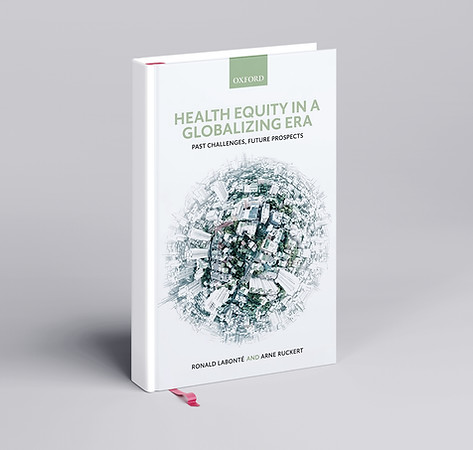
Globalization and Health Work in the globalization area focused primarily on the global neoliberal economic era (post 1980) and its far-reaching effect on health and access to the social, economic, and environmental resources needed for health. Domestic economic policy and regulatory measures figure prominently, as does trade and investment liberalization’s impacts on economic development, labour markets, debt and taxation, wealth and income distribution, and health systems access. Excess consumption of environmental resources and high levels of toxic emissions are imperilling planetary health. As one of the key publication notes, globalization may be driven by how it is determined by, and determines, economic relations of power, but it also has more nuanced outcomes in terms of peoples’ experiences of time, space, and knowledge. As a sociopolitical phenomenon it predates the contemporary neoliberal era, and even the post-feudal rise of capitalism, and was manifest as empires in earlier historic periods. (see: Health equity in a globalizing era: past challenges, future prospects, Oxford University Press. 2019.) Key Publications Books Labonté, R., and Ruckert, A. Health equity in a globalizing era: past challenges, future prospects, Oxford University Press. 2019. https://academic.oup.com/book/34974 Summarizes almost 30 years of research; awarded 2021 Book of the Year by the British Medical Association Labonté, R., Schrecker, T., Sanders, D., Meeus, W. Fatal Indifference: The G8 and Global Health. Cape Town: University of Cape Town Press/IDRC Books. 2004. Access at: http://hdl.handle.net/10625/31263 One of the first critical texts interrogating how the different facets of globalization influence health outcomes. Labonte, R., Schrecker, T., Packer, C. and Runnels, V. (eds.). Globalization and Health: Pathways, Evidence and Policy, Routledge. 2009. https://www.academia.edu/180824/Globalization_and_Health_Pathways_Evidence_and_Policy An edited collection of some of the contributions of the Globalization Knowledge Network to the WHO Commission on Social Determinants of Health. Publications and Presentations Many of the articles were published in the open access BMC journal, Globalization and Health (https://link.springer.com/journal/12992). I have been involved with this journal since its founding in 2005 and one of its lead editors since 2014. NEW ONE FROM GLAH Labonté, R., Martin, G., Storeng, K. “Editorial: Whither globalization and health in an era of geopolitical uncertainty?” Globalization and Health (2022) pp.1-4. https://globalizationandhealth.biomedcentral.com/articles/10.1186/s12992-022-00881-x Labonté, R (2020) “Editorial: Editorial: Globalization and Health Scholarship in a Time of Pandemic: From Critical Past to Uncertain Future,” Globalization and Health (2020) 16(31): 1-3. https://rdcu.be/b3BlG Yaya, S., Out, A., Labonté R. “Globalisation in the time of COVID-19: repositioning Africa to meet the immediate and remote challenges,” Globalization and Health (2020) 16:51 pp.1-7. https://globalizationandhealth.biomedcentral.com/track/pdf/10.1186/s12992-020-00581-4 Martin, B., MacLachlan, M., Labonté, R., Larkin, F., Vallieres, F., and Bergin, N. “Globalization and Health: developing the journal to advance the field,” Globalization and Health (2016) 12(6): 1-9. http://www.globalizationandhealth.com/content/pdf/s12992-016-0143-2.pdf Baum, F., Sanders, D., Fisher, M., Anaf, J., Freudenberg, N., Friel, S., Labonté, R., London, L., Scott-Samuel, A., Sengupta, A. “Assessing the health impact of transnational corporations: its importance and a framework,” Globalization and Health (2016) 12(27):1-7. http://globalizationandhealth.biomedcentral.com/articles/10.1186/s12992-016-0164-x Labonté, R., “Reprising the globalization dimensions of international health,” Globalization and Health (2018), 14(49):1-5. https://link.springer.com/article/10.1186/s12992-018-0368-3 Labonté R, Cobbett E, Orsini M, Spitzer D, Schrecker T and Ruckert A. Globalization and the Health of Canadians: ‘Having a Job is the Most Important Thing‘ Globalization and Health, 2015 Labonté, R. “From the Myth of Level Playing Fields to the Reality of a Finite Planet,” International Journal of Health Policy and Management (2015) 5:2 137-139. http://ijhpm.com/article_3130_b28fcfbe1f6089b1430c18fd2b66af8b.pdf Caldbick, S., Labonté, R., Mohindra, K.S., and Ruckert, A. “Globalization and the rise of precarious employment: the new frontier for workplace health promotion,” Global Health Promotion 2014, 1757-9759; Vol 21(2):23-32. http://ped.sagepub.com/content/early/2014/02/17/1757975913514781.full.pdf+html Ruckert, A., and Labonté, R. “The global financial crisis and health equity: early experiences from Canada,” Globalization and Health 2014, 10:2 http://globalizationandhealth.biomedcentral.com/articles/10.1186/1744-8603-10-2 Brown, G.W., Labonté, R. Globalization and its methodological discontents: Contextualizing globalization through the study of HIV/AIDS. Globalization and Health 7, 29 (2011). https://doi.org/10.1186/1744-8603-7-29 Labonté, R., Mohindra K., and Schrecker, T. "The Growing Impact of Globalization for Health and Public Health Practice", Annual Review of Public Health. 32, 2011: 263-83. https://www.researchgate.net/publication/49740771_The_Growing_Impact_of_Globalization_for_Health_and_Public_Health_Practice Schrecker, T., Labonté, R. and De Vogli, R. “Globalisation and health: the need for a global vision”, The Lancet 372(9650):1670-1676, 2008. https://www.researchgate.net/publication/23460263_Globalisation_and_Health_The_Need_for_a_Global_vision Labonté, R and Schrecker, T. “Globalization and the social determinants of health: Introduction and methodological background” (part 1 of 3) Globalization and Health 3(5):1-10. 2007. https://link.springer.com/article/10.1186/1744-8603-3-5 Labonté, R. and Schrecker, T. “Globalization and the social determinants of health: The role of the global marketplace” (part 2 of 3) Globalization and Health 3(6): 1-17. 2007. https://link.springer.com/article/10.1186/1744-8603-3-6 Labonté, R. and Schrecker, T. “Globalization and the social determinants of health: Promoting health equity in global governance” (part 3 of 3) Globalization and Health 3(7): 1-15. 2007. https://link.springer.com/article/10.1186/1744-8603-3-7 Labonté, R. and Torgerson, R. “Interrogating Globalization, Health and Development: Towards a Comprehensive Framework for Research, Policy and Political Action”, Critical Public Health 15(2):157-79. 2005. New Tab: Globalization Knowledge Network In 2005, the World Health Organization established the Commission on Social Determinants of Health. The Globalization Knowledge Network, based at the Institute of Population Health, is one of nine Knowledge Networks supporting the work of the Commission; it submitted its final report to the Commission in June 2007. Among the aspects of globalization on which it focused are: trade liberalization the global integration of production of goods, consumption and lifestyle patterns the “asymmetrical” distribution of globalization’s gains and losses. The final report of the Commission can be found here: Closing the gap in a generation: health equity through action on the social determinants of health https://www.who.int/publications/i/item/9789241563703 The final report of the Globalization Knowledge Network is here: Towards Health-Equitable Globalisation: Rights, Regulation and Redistribution. Ottawa: January 2008. The background papers follow: Trade Liberalization Synthesis Paper by Chantal Blouin, 2007 Intellectual Property Rights and Inequalities in Health Outcomes by Carlos M. Correa, 2008 ‘Globalization and Health Systems Change’ by John Lister and Ronald Labonte, in Ronald Labonte, Ted Schrecker , Corinne Packer and Vivien Runnels (Eds). Globalization and Health: Pathways, Evidence and Policy. Globalization and Health Worker Crisis by Corinne Packer, Ronald Labonte and Denise Spitzer, 2007 Globalization Global Governance and Social Determinants of Health by Kelley Lee, Meri Koivusalo, Eeva Ollila, Ronald Labonte, Ted Schrecker, Claudio Schuftan, David Woodward, 2007 Global Political Economy and Geopolitical Trends, Structures and Implications for Public Health by Patrick Bond, 2008 Globalization, Debt and Poverty Reduction Strategies by Michael Rowson, 2007 Globalization, Water and Health WHO Commission on SDH by J.Zoe Wilson and Patrick Bond, 2008 Globalization and Health: Impact Pathways and Recent Evidence by Giovanni Andrea Cornia, Stefano Rosignoli and Luca Tiberti, 2008 Globalization Food and Nutrition Transitions by Corinna Hawkes, 2007 ‘Global Financing for Health: Aid and Debt Relief‘, by Sebastien Taylor and Michael Rowson, in Ronald Labonte et al. (Eds.), Globalization and Health: Pathways, Evidence and Policy. Globalisation and Policy Space for Health and Social Determinants of Health by Meri Koivusalo, Ted Schrecker and Ronald Labonte, in Labonte et al. (Eds.), Globalization and Health: Pathways, Evidence and Policy.
Health Promotion The Ottawa Charter for Health Promotion (1986) is one of the seminal declarations that made health promotion a commonly invoked and rapidly globalized practice in public health, displacing the earlier dominant concept of health education. The Charter defines health promotion as ‘the process of enabling people to increase control over, and to improve, their health’ a riff on the definition I coined in 1981 as ‘the process of empowering people to take control over, and responsibility for, their health’, but with an emphasis on acting on the ‘socially pathogenic issues and structures’ that determined their health. This 1981 monograph was printed by mimeo, predating any digital age, and so lives in an old office filing cabinet. But its analysis suffused my health promotion work from the mid-1970s onwards, reflecting very much the social critiques of various social movements of the era: anti-poverty, anti-racism/civil rights, feminism, environmentalism, New Left (socialism/Marxist economics), labour and human rights. At base, I understood health promotion (a term I never liked much) as an exercise in doing social justice, informed by critical theory. And only and ever in concert with the progressive local, national and (only later) global social activist groups. My early health promotion scholarship, generated during my almost two decades of full-time work as a health promoter for local and provincial health departments in Canada, attracted a lot of attention, including as it did a lot of practical reflection on what an ‘empowering’ health promotion practice looked like. Two key publications summarize much this work (Labonté and Laverack 2008, and Labonté 1993). As some of the publications below indicate, I have continued with some scholarly work in the health promotion area; but most of my active work on this theme began to fade in the mid-1990s. I spent much of the 1990s working internationally running workshops and contributing to research based on the empowerment models of health promotion I had developed in the 1980s. In country after country I encountered public health workers complaining of retrenchment and lack of support for the social justice underpinnings of health promotion, leading me to speculate that there must be global forces at work, if this was becoming such an international experience. I pivoted, then, to examining how globalization was affecting nation states, and hence regional and local health authorities’, resources and capabilities for the ‘radical’ health promotion on which my own work was weaned for two decades. As such, many of the publications here are older; in that sense, they can be considered foundational, for there is essentially nothing that I wrote on this topic over 40 years ago with which I disagree, or that I find irredeemably dated. Key Publications Books Labonté, R. and Laverack, G. Health Promotion in Action: From Local to Global Empowerment, London: Palgrave Macmillan. 2008. https://www.academia.edu/93109021/Health_Promotion_in_Action_From_Local_to_Global_Empowerment This book represents one of my most recent syntheses of health promotion, with several chapters co-written with a former doctoral student who brings his own unique approach to health promotion and empowerment studies. Labonté, R. Health Promotion and Empowerment: Practice Frameworks, Toronto: Centre for Health Promotion/Participation. 1993. https://www.researchgate.net/publication/246362374_Health_Promotion_and_Empowerment_Practice_Frameworks This short book distills empowerment practice models approaches that have influenced a generation of health promotion practitioners. The models have formed the bases of graduate student theses and research applications. Publications and Presentations Labonté, R., “Globalization: The Perils and Possibilities for an Equitable Health Promotion,” in Pederson, A., Lapalme, J., Frohlich, K., Feriatte, O., and Dupéré. S. (eds). Health Promotion in Canada 5th Edition Toronto: Canadian Scholars Press, 2025 pp.289-306. https://canadianscholars.ca/book/health-promotion-in-canada-fifth-edition/ Khayatzadeh-Mahani, A., Ruckert, A., Labonté, R., Kenis, P., and Akbar-Javar M.R., “Health in All Policies (HiAP) governance: lessons from network governance,” Health Promotion International (2018), 1-13. https://academic.oup.com/heapro/article/34/4/779/5004396 Labonté, R., “From mid-level policy analysis to macro-level political economy: Comment on ‘Developing a framework for a program theory-based approach to evaluating policy processes and outcomes: Health in All Policies in South Australia’”. International Journal of Health Planning and Management, (2018), 1-3. http://www.ijhpm.com/article_3461_94c70657b0a6d24d76eaf52a17fcd1df.pdf Labonté, R., “Health Promotion in an Age of Normative Equity and Rampant Inequality,” International Journal of Health Policy and Management (2016), 5(12), 675-82 http://www.ijhpm.com/article_3243_9cfe55f382f6c9876bd955b41b2c9007.pdf Baum, F. and Labonté R., “Healthwash in Helsinki,” Health Promotion International 2013 p.141-3. https://doi.org/10.1093/heapro/dat054 Labonté, R. “Toward a post-Charter Health Promotion,” Health Promotion International, 2011. 26(S2):1183-1186. https://www.academia.edu/106070342/Toward_a_post_Charter_health_promotion Labonté, R. “Reflections on Stories and a Story/Dialogue Method in Health Research”, International Journal of Social Research Methodology. 13(4):1-11, 2010. https://www.researchgate.net/publication/12762599_A_storydialogue_method_for_health_promotion_knowledge_development_and_evaluation Labonté, R. “The Future of Health Promotion”, Health Promotion Journal of Australia 16(3):172-75. 2006. [IF:1.089] https://www.researchgate.net/publication/7396291_The_future_of_health_promotion Labonté, R. “Social inclusion/exclusion: Dancing the dialectic” Health Promotion International 19(1):115-21. 2004. https://www.researchgate.net/publication/8687562_Social_inclusionexclusion_Dancing_the_dialectic Labonté, R. “Health promotion in the near future: remembrances of activism past”, Health Education Journal 58:365-77. 1999. https://www.researchgate.net/publication/249806757_Health_promotion_in_the_near_future_remembrances_of_activism_past Labonté, R., Feather, J. and Hills, M. “A story/dialogue method for health promotion knowledge development and evaluation”, Health Education Research 14(1): 39-50. 1999 https://www.researchgate.net/publication/12762599_A_storydialogue_method_for_health_promotion_knowledge_development_and_evaluation Labonté, R. “Health promotion and the common good: Towards a politics of practice”, Critical Public Health 8(2): 107-29. 1998. https://www.researchgate.net/publication/233118121_Health_promotion_and_the_common_good_Towards_a_politics_of_practice Labonté, R. and Robertson, A. "Health promotion research and practice: The case for the constructivist paradigm", Health Education Quarterly 23(4): 431-47. 1996. https://www.researchgate.net/publication/14297106_Delivering_the_Goods_Showing_Our_Stuff_The_Case_for_a_Constructivist_Paradigm_for_Health_Promotion_Research_and_Practice Labonté, R. "Population health and health promotion: What do have to say to each other?" Canadian Journal of Public Health 86(3): 165-68. 1995 https://www.researchgate.net/publication/15528357_Population_health_and_health_promotion_What_do_they_have_to_say_to_each_other Labonté, R. "Health promotion and empowerment: reflections on professional practice", Health Education Quarterly 21(2): 253-68. 1994. https://www.researchgate.net/publication/15178396_Health_Promotion_and_Empowerment_Reflections_on_Professional_Practice Labonté, R. "A holosphere of healthy and sustainable communities", Australian Journal of Public Health 17(1): 4-12. 1993 https://www.researchgate.net/publication/14841195_A_holosphere_of_healthy_and_sustainable_communities Labonté, R. "Heart health inequalities in Canada: Models, theory and planning", Health Promotion International 7(2):119-28. 1992. https://www.researchgate.net/profile/Ronald-Labonte/publication/31270252_Heart_health_inequalities_in_Canada_Modules_theory_and_planning/links/579a204008ae024e100e3be9/Heart-health-inequalities-in-Canada-Modules-theory-and-planning.pdf Labonté, R. "Econology: integrating health and environment", Health Promotion International 6(1): 49-65. 1991. https://www.researchgate.net/publication/249278178_Econology_Integrating_health_and_sustainable_development_Part_one_Theory_and_background Labonté, R. "Principles for sustainable development decision-making", Health Promotion International 6(2): 147-56. 1991. https://www.researchgate.net/publication/249278078_Econology_integrating_health_and_sustainable_development_Guiding_principles_for_decision-making Labonté, R. "Health promotion: from concepts to strategies", Healthcare Management Forum 1(3): 24-30. 1988. https://www.researchgate.net/publication/12995417_Health_Promotion_From_Concepts_to_Strategies Labonté, R. and Penfold, S. "Canadian perspectives in health promotion: a critique." Health Education 19:4-9. 1981. https://www.researchgate.net/publication/284588683_Canadian_perspectives_in_health_promotion_A_critique New tab: Community Development Community development is the process of bringing people together to work on common goals and solutions, improving their collective well-being, which includes economic, social, and environmental aspects. It involves communities identifying issues or opportunities and taking collaborative action through strategies like advocacy, capacity building, and relationship-building. In my earlier health promotion work community development was considered one of the key strategies for advancing a health social justice agenda. It overlaps very much with the concept of empowerment. Publications and Presentations Williams, A., Labonté, R., Muhajarine, N., Randall, J. and Holden, B. “Establishing and sustaining community-university partnerships: A case study of quality of life”, Critical Public Health 15(3):291-302. 2005. https://www.researchgate.net/publication/244887790_Establishing_and_Sustaining_Community-University_Partnerships_A_Case_Study_of_Quality_of_Life_Research Gibbon, M., Labonté, R. and Laverack, G. “Evaluating community capacity: A practical approach”, Health and Social Care in the Community 10(6): 485-491. 2002. https://www.researchgate.net/publication/227628700_Evaluating_community_capacity_Health_Soc_Care_Community Labonté, R. and Laverack, G. “Capacity Building in Health Promotion: For Whom? And For What Purpose?”, Critical Public Health 11(2):111-27. 2001. https://www.researchgate.net/publication/244887834_Capacity_building_in_health_promotion_Part_I_For_whom_And_for_what_purpose Labonté, R. and Laverack, G. “Capacity Building in Health Promotion: What Should We Measure? And How?”, Critical Public Health 11(2):129-38. 2001. https://www.researchgate.net/publication/252581165_Capacity_building_in_health_promotion_Part_2_Whose_use_And_with_what_measurement Labonté, R. “Social capital and community development”, Australian and New Zealand Journal of Public Health 23(4): 93-96. 1999. [IF: 1.897] https://www.researchgate.net/publication/12836841_Social_Capital_and_Community_Development Labonté, R. "Community development and partnerships”, Canadian Journal of Public Health 84(4): 237-40. 1993. [IF:1.399] https://www.researchgate.net/publication/14976783_The_view_from_here_Community_development_and_partnerships New tab: Empowerment Books Labonté, R. and Laverack, G. Health Promotion in Action: From Local to Global Empowerment, London: Palgrave Macmillan. 2008. https://www.academia.edu/93109021/Health_Promotion_in_Action_From_Local_to_Global_Empowerment Labonté, R. Health Promotion and Empowerment: Practice Frameworks, Toronto: Centre for Health Promotion/Participation. 1993. https://www.researchgate.net/publication/246362374_Health_Promotion_and_Empowerment_Practice_Frameworks Publications and Presentations Labonté, R. “Chapter 14: Health promotion and empowerment: reflections on professional practice,” in Philosophical Foundations of Health Education; Jossey-Bass (2010). https://sdh.gmu.ac.ir/Dorsapax/userfiles/file/JillMBlackStevenRFurneyHelenMGraf.pdf Williams, L. and Labonté, R. “Empowerment for migrant communities: Paradoxes for practitioners”, Critical Public Health 17(4): 365-379. 2007. Williams, L., Labonté, R. and O’Brien, M. “Empowering social action through narratives of identity and culture”, Health Promotion International 18(1):33-40. 2003. Williams, L. and Labonté, R. “Community health determinants through community action: power participation and policy”, International Journal of Health Promotion and Education X(2):65-71. 2003. Labonté, R. "Empowerment: Notes on professional and community dimensions", Canadian Review of Social Policy 26: 64-75. 1990. https://www.researchgate.net/publication/284319863_Empowerment_Notes_on_professional_and_community_dimensions New tab: Societal Determinants of Health Publications and Presentations Labonté, R., “Purveyors of the commercial determinants of health have no place at any policy table. Full stop.” International Journal of Health Policy and Management (2020) pp.1-3. https://www.ijhpm.com/article_3907.html Ruckert, A., Huynh, C. and Labonté, R "Reducing health inequities: Is universal basic income the way forward?" Journal of Public Health (2018) 40(1):3-7. https://doi.org/10.1093/pubmed/fdx006 Ruckert, A., Labonté, R., “The First Federal Budget under Prime Minister Justin Trudeau: Addressing Social Determinants of Health?” Canadian Journal of Public Health (2016) 107(2):212-214 https://www.researchgate.net/publication/306106335_The_first_federal_budget_under_Prime_Minister_Justin_Trudeau_Addressing_social_determinants_of_health Ruckert, A. and Labonté, R., “The social determinants of health,” in G.W. Brown, G. Yamey and S. Wamala (eds.). The Handbook of Global Health Policy, Wiley-Blackwell, 2014. Pp.267-85. https://www.researchgate.net/publication/398211208_The_Social_Determinants_of_Health Labonté, R. “Global action on social determinants of health,” Journal of Public Health Policy 33(2):139-47, 2012. https://www.researchgate.net/publication/221778064_Global_action_on_social_determinants_of_health Ostlin, P., Schrecker, T., Sadana, T., Bonnefoy, J., Gilson, L., Hertzman, C., Kelly, M., Kjellstrom,, T., Labonté, R., Lundberg, O., Muntaner, C., Popay, J., Sen, G. and Vaghri, Z. “Priorities for research on equity and health: towards an equity-focused third wave of health research,” PLoS Medicine 8(11): e1001115. https://www.researchgate.net/publication/51785158_Priorities_for_Research_on_Equity_and_Health_Towards_an_Equity-Focused_Health_Research_Agenda Bryant, T., Raphael, D., Schrecker, T. and Labonté, R., Canada: “A Land of Missed Opportunity for Addressing the Social Determinants of Health” Health Policy doc.10.1026/j.healthpol.2010.08.022, 2010: 1-15. https://www.researchgate.net/publication/47298612_Canada_A_land_of_missed_opportunity_for_addressing_the_social_determinants_of_health Blas, E., Gilson, L., Kelly, MP., Labonté, R., Lapitan, J., Muntaner, C., Ostlin, P., Popay, J., Sadana, R., Sen, G., Schrecker, T. and Vagri, Z. “Addressing social determinants of health inequities: what can the state and civil society do?”, The Lancet 372(9650):1684-1689, 2008. https://www.researchgate.net/publication/276205985_Addressing_social_determinants_of_health_inequities_what_can_the_state_and_civil_society_do Frankish, J., Moulton, G., Quantz, D. Carson, A., Casebeer, A., Eyles, J., Labonté, R. and Evoy, B. “Addressing the Non-medical Determinants of Health: A Survey of Canada’s Health Region”, Canadian Journal of Public Health 98(1):41-47. 2006. https://www.researchgate.net/publication/6525468_Addressing_the_Non-medical_Determinants_of_Health_A_Survey_of_Canada's_Health_Regions
Political Economy of Health Political economy is an interdisciplinary field that studies the relationship between political forces and economic systems. It examines how politics, public policy, and economics influence each other, considering factors like government (governance), social structures (class, race, gender and other systems of stratification), and historical context (path dependency, ideology) in economic analysis. This field argues that it is not possible to understand one without the other, and it draws from economics (classical, heterodox, feminist, ecological, and radical), sociology (interrogating how power defined relations between state, market, and civil society), and political science (the study of systems of government and governance). Political economy of health, in turn, examines how these different pathways manifest as health outcomes, via social/societal determinants of health. While a political economy analysis permeates much of my past research and scholarship, two themes are highlighted on this page: neoliberalism, and tobacco control. Key Publications New tab: Neoliberalism Neoliberalism is considered a recent (post-1980) extension of classical economic liberalism as theorized by 17th and 18th century European writers, such as Jeremy Bentham, John Stuart Mill and Adam Smith. As one of the key publications argues, the formulation of contemporary neoliberal economics is largely credited to the Austrian/America economist, Friedrich von Hayek, and became the dominant international order when the rise of conservative politics in the USA, the UK and Germany merged with one of capitalism’s intermittent crises, in this instance the oil price shocks of the 1970s and the ensuing developing country debt crisis (Labonté and Stuckler 2016). This confluence of forces created space for neoliberalism’s theoretical arguments to gain political traction, and then spread globally via the imposed financial rescue packages of the World Bank and International Monetary Fund. There is recent (post 2025) argument that the second US Trump administration has ended neoliberalism as the dominant global economic order, although many of its market fundamentalist and government minimalist practices remain (see Global Health Watch 7 2025). Publications and Presentations McNamara, C., Kotzias, V., Bambra, C., Labonté, R., Stuckler, D. “Have COVID-19 Stimulus Packages Mitigated the Negative Health Impacts of Pandemic-Related Job Losses? A Systematic Review of Global Evidence from the First Year of the Pandemic,” International Journal of Social Determinants of Health and Health Services 53(3):1-12, 2023. https://doi.org/10.1177/27551938231176374 Baker, P., Lacy-Nichols, J., Williams, O., Labonté, R., “The political economy of healthy and sustainable food systems: an introduction to a Special Issue,” International Journal of Health Policy and Management 2021, 10(12), 734–744 https://www.ijhpm.com/article_4167_cbfb5becc4f149adb4fe616516182298.pdf Labonté, R., “Neoliberalism 4.0: The Rise of Illiberal Capitalism,” International Journal of Health Policy and Management (2020) 9(4):175-8. http://www.ijhpm.com/article_3694_93cd3be37ae499fb96503dcf0c569508.pdf Ruckert, A. and Labonté, R., “Health inequities in the age of austerity: The need for social protection policies” Social Science and Medicine (2017) 187:306-11. http://dx.doi.org/10.1016/j.socscimed.2017.03.029 Labonté, R., “Framing Political Change: Can a Left Populism Disrupt the Rise of the Reactionary Right?” International Journal of Health Policy and Management 6(x):1-3 (2017) http://www.ijhpm.com/article_3310_dc8038ef948c296e6fbee33bf3f5d3f3.pdf Labonté, R. and Stuckler, D., “The rise of neoliberalism: How bad economics imperils health and what to do about it,” Journal of Epidemiology and Community Health (2016) 70(3):312-318 http://jech.bmj.com/content/70/3/312.full Labonté, R. and Ruckert, A. “Austerity Lite: Social Determinants of Health under Canada’s Neo-Liberal Capture,” in McBride, S., Boychuk, G. and Mahon, R. (eds.) After 08 (2015) Vancouver: UBC Press (pp. 272-291). https://www.researchgate.net/publication/383682440_Austerity_Lite_Social_Determinants_of_Health_under_Canada's_Neo-Liberal_Capture Ruckert, A., Labonté, R., and Parker, R. “Global healthcare policy and the austerity agenda,” in Kuhlmann, E., Blank, R., Bourgeault, I., and Wendt, C. (eds.) The Palgrave International Handbook of Healthcare Policy and Governance, New York: Palgrave Macmillan, 2015 pp.37-53. https://www.researchgate.net/publication/298517860_Global_Healthcare_Policy_and_the_Austerity_Agenda Ruckert, A., Caldbick, S. and Labonté, R. “Equity in Times of Austerity: Ontario’s Revenue Crisis in Historical Perspective” Canadian Review of Social Policy 72/73 (2015): 30-63. https://www.researchgate.net/publications/create?publicationType=article Akintola, G., Gwelo, N.B., Labonté, R. and Appadu, T., “The global financial crisis: experiences of and implications for community-based organizations providing health and social services in South Africa” Critical Public Health. Vol. 26, No. 3, 307–321, http://dx.doi.org/10.1080/09581596.2015.1085959 Ruckert, A., and Labonté, R. “The global financial crisis and health equity: early experiences from Canada,” Globalization and Health, 2014 https://link.springer.com/article/10.1186/1744-8603-10-2 Labonté, R. “The austerity agenda: how did we get there and where do we go next?” Critical Public Health, 22:3, 257-265, 2012. https://www.academia.edu/2651681/The_Austerity_Agenda_How_Did_We_Get_There_and_Where_Do_We_Go_Next Ruckert, A. and Labonté, R. “The Financial Crisis and Global Health: The International Monetary Fund’s (IMF) Policy Response.” Health Promotion International, 2012 https://www.researchgate.net/publication/224038720_The_financial_crisis_and_global_health_The_International_Monetary_Fund's_IMF_policy_response Ruckert, A. and Labonté, R. “The Global Financial Crisis and Health Equity: Towards a Conceptual Framework,” Critical Public Health, 22:3, 267-279, 2012. https://www.researchgate.net/publication/225009750_The_Global_Financial_Crisis_and_Health_Equity_Toward_a_Conceptual_Framework Mohindra, K., Labonté, R. and Spitzer, D. “The Global Financial Crisis: Whither Women’s Health?” Critical Public Health. 21(3):273-288, 2011. https://www.researchgate.net/publications/create?publicationType=article Labonté, R., (ed.) Forgotten Families: Globalization and the Health of Canadians, Ottawa: Collection d’études transdisciplinaires en santé des populations/Transdisciplinary Studies in Population Health Series, 2010. https://www.academia.edu/761852/Forgotten_Families_Globalization_and_the_Health_of_Canadians Labonté, R. “The Global Financial Crisis and Health: Scaling Up Our Effort”, Canadian Journal of Public Health 100(3): 173-75. 2009 Macdonald, J., Raphael, D., Labonté, R., Colman, R., Torgerson, R. and Hayward, K. “Income and health in Canada: Canadian researchers’ conceptualizations make policy change unlikely,” International Journal of Health Services 2009. 525-543. https://www.researchgate.net/publication/26829305_Income_and_Health_in_Canada_Canadian_Researchers'_Conceptualizations_Make_Policy_Change_Unlikely Raphael, D., Labonté, R., Colman, R., Hayward, K. Torgerson, R., Macdonald, J. Income and Health in Canada: Research gaps and future opportunities, Canadian Journal of Public Health, 2006. https://www.researchgate.net/publication/6448734_Income_and_health_in_Canada_Research_gaps_and_future_opportunities New tab: Tobacco Control The goal of this multi-year, multi-funded set of research studies (2013-2023) was to identify and explain the political economy of the intersection of public health policy and tobacco control, focusing in its first five year funded study (2013-2018) on three sub-Saharan African countries (Kenya, Zambia, and Malawi). The impetus for this study was that, as tobacco control measures increased in high-income countries, tobacco transnationals focused more on growing more markets in low- and middle-income countries, notably in Africa. One of the ways in which they attempt to influence tobacco control measures in these countries is by emphasizing the importance of tobacco farming on rural livelihoods, and countries’ foreign exchange earnings and economic development. The multi-method studies under this research program challenge these arguments empirically and theoretically. A second five-year study (2017-2022) deepens the research in these three SSA countries, and adds Indonesia to the group. The second study period focuses more on tobacco farmer livelihoods, and alternatives to tobacco as a viable economic crop. In 2019, with new four-year funding from the Canadian Institutes of Health Research (CIHR), two new SSA countries joined the research project: Zimbabwe and Mozambique (2019-2023). Publications and Presentations Clark, M., Cunguara, B., Bialous, S., Rice, K., Drope, J., Labonté, R., Lencucha, R. “Foregrounding women and household dynamics to inform Article 17: a qualitative description analysis of tobacco farming households in Mozambique,” Tobacco Control 0-7, (2023); https://tobaccocontrol.bmj.com/content/tobaccocontrol/early/2023/07/03/tc-2022-057881.full.pdf Ruckert, A., Labonté, R., Lencucha, R., Goma, F., Drope, J. “Exploring the political economy nexus of tobacco production and control: a case study from Zambia,” Critical Public Health 2022; 33(1):25-36. https://www.tandfonline.com/doi/full/10.1080/09581596.2021.1981540 Lencucha, R., Drope, J., Labonté, R., Cunguars, B., Ruckert, A., Mlambo, Z., Kadungure, A., Bialous, S., Nhamo, N. “The Political Economy of Tobacco in Mozambique and Zimbabwe: A Triangulation Mixed Methods Protocol,” International Journal of Environmental Research and Health (2020) 17:4262:1-13. https://www.mdpi.com/1660-4601/17/12/4262 Lencucha, R., Moyo, T., Labonté, R., Drope, J., Appau, A., Makoka, D. “Shifting from tobacco growing to alternatives in Malawi? A qualitative analysis of policy and perspectives,” Health Policy and Planning (2020) 1-9. https://doi.org/10.1093/heapol/czaa057 Clark, M., Magati, P., Drope, J., Labonté, R., Lencucha, R. “Understanding alternatives to tobacco production in Kenya: A qualitative analysis at the sub-national level,” International Journal of Environmental Research and Public Health (2020) 17(6): 1-13. https://www.mdpi.com/1660-4601/17/6/2033 Labonté, R., Lencucha, R., Goma, F., Zulu, R., & Drope, J. “Consequences of policy incoherence: how Zambia’s post-FCTC investment policy stimulated tobacco production” Journal of Public Health Policy (2019) 40 (3): 286-291 https://www.researchgate.net/publication/332859794_Consequences_of_policy_incoherence_how_Zambia's_post-FCTC_investment_policy_stimulated_tobacco_production Li, Q., Magati, P., Lencucha, R., Labonté, R., Makoka, D., Drope, J. “The Economic Geography of Kenyan Tobacco Farmers’ Livelihood Decisions” Nicotine and Tobacco Research (2019) 1-4 https://academic.oup.com/ntr/advance-article/doi/10.1093/ntr/ntz011/5301465?searchresult=1 Magati, P., Lencucha, R., Li, Q., Drope, J., Labonté, R., Appau, A., Makoka, D., Goma, F. & Zulu, R. "Costs, Contracts and the Narrative of Prosperity: An Economic Analysis of Smallholder Tobacco Farming Livelihoods in Kenya” Tobacco Control (2019) 28(3): 268-273. https://tobaccocontrol.bmj.com/content/early/2018/07/02/tobaccocontrol-2017-054213.full Lencucha, R., Ruckert, A., Drope, J., Labonté, R. “Opening windows and closing gaps: Canada’s 2009 tobacco additives ban and its policy lessons,” BMC Public Health (2018) 18:1321. https://rdcu.be/bb7CT Lencucha, A., Reddy, S., Labonté, R., Drope, J., Magati, P., Goma, F., Zulu, R. and Makoka, D. “Global tobacco control and economic norms: an analysis of normative commitments in Kenya, Malawi and Zambia,” Health Policy and Planning (2018):1- 8, https://academic.oup.com/heapol/advance-article-abstract/doi/10.1093/heapol/czy005/4833987?redirectedFrom=fulltext Labonté, R., Lencucha, R., Drope, J., Packer, C., Goma, F., and Zulu, R. “The institutional context of tobacco production in Zambia,” Globalization and Health (2018) 14:5: pp.1-12. https://globalizationandhealth.biomedcentral.com/articles/10.1186/s12992-018-0328-y Goma, F, J Drope, R Zulu, Q Li, G Chelwa, R Labonté, J Banda. 2017. “The Economics of Tobacco Farming in Zambia” (Revised version) Lusaka: University of Zambia School of Medicine and Atlanta: American Cancer Society. https://www.cancer.org/content/dam/cancer-org/research/economic-and-healthy-policy/economics-tobacco-farming-zambia-2017.pdf Appau, A., Drope, J., Labonté, R., Stoklosa, M, Lencucha, R., "Disentangling regional trade agreements, trade flows and tobacco affordability in Sub-Saharan Africa" Globalization and Health (2017) 13:81: pp.1-12. https://link.springer.com/content/pdf/10.1186/s12992-017-0305-x.pdf Lencucha, R., Labonté, R., and Drope, J. “Rhetoric and the Law, or the Law of Rhetoric: How countries oppose novel tobacco control at the WTO,” Social Science and Medicine. (2016) 164:100-107. http://www.sciencedirect.com/science/article/pii/S0277953616303872 Magati P, Li Q, Drope J, Lencucha R, Labonté, R, 2016 The Economics of Tobacco Farming in Kenya. 2016. International Institute for Legislative Affairs and American Cancer Society, Nairobi. https://www.researchgate.net/publications/create?publicationType=article Makoka D, A Appau, R Lencucha, J Drope. 2016. Farm-Level Economics of Tobacco Production in Malawi. Lilongwe: Centre for Agricultural Research and Development and Atlanta: American Cancer Society. https://www.researchgate.net/publications/create?publicationType=article Makoka, D., Appau, A., Drope, J., Labonté, R., Li, Q., Goma, F., Zulu, R., Magati, P. & Lencucha, R. (2016) “Costs, revenues and profits: An economic analysis of smallholder tobacco farmer livelihoods in Malawi,” Tobacco Control 26(6):634-40. https://www.researchgate.net/publication/308953188_Costs_revenues_and_profits_An_economic_analysis_of_smallholder_tobacco_farmer_livelihoods_in_Malawi Labonté, R. and Lencucha, R. “Regulating Electronic Cigarettes: Between Precaution and Harm Reduction,” Canadian Medical Association Journal. CMAJ cmaj.150347, May 11, 2015. https://www.academia.edu/16709039/Regulating_electronic_cigarettes_finding_the_balance_between_precaution_and_harm_reduction?uc-g-sw=58218472 Lencucha, R., Drope, J., Labonté, R., Goma, F. and Zulu, R. “Investment Incentives and the Implementation of the Framework Convention on Tobacco Control: Evidence from Zambia” Tobacco Control July 6, 2015. https://www.researchgate.net/publication/279729645_Investment_Incentives_and_the_Implementation_of_the_Framework_Convention_on_Tobacco_Control_Evidence_from_Zambia
Wellbeing Economics Public health has tended to grapple with economics only in cursory ways, as some of the publications in the section on Political Economy of Health discuss. Health economics often defaults to health (medical) care economics, using cost/benefit analyses to determine the greatest health return per level of capital (financial and/or human) expenditure. A legacy of health behavourism critiques in several of the publications in the Health Promotion section, ‘nudge’ economics attempts to use economic carrots (financial incentives) or sticks (financial penalties) to induce people to adopt healthier ‘lifestyle’ behaviours. In the background, however, there has always been minority concerns with the disequalizing and toxic impacts of capitalism as an economic model. While generating growth and growth-associated health gains (albeit grossly maldistributed), capitalism relies upon consumption of natural resources, income inequalities, and profit (capital accumulation) as the prime social directive. Climate catastrophe and the increasing pace of financial crises, compounded by the rise in pandemic threats and anti-microbial resistance (discussed in many of the publications under Global1HN), has led to a number of new ‘post-capitalist’ economic models and policy prescriptions, from degrowth/postgrowth to doughnut economics to ‘wellbeing economics.’ This latter concept, while running the risk of performative politics with little change in ‘business as usual’ practices that are killing planet and people, nonetheless has some positive attributes that could help in a transformative shift into something other than the autocratic rule and kleptocratic greed that the recent second Trump presidency has escalated. Reports Labonté, R. Muhajarine, N., Winquist, B., Quail, J. Healthy Populations Domain of the Canadian Index of Wellbeing. Toronto: CIW Foundation, 2010. Publications and Presentations Labonté, R., “Wellbeing economies: a harder but still important health advocacy goal,” International Journal of Health Policy and Management, 2025; https://www.ijhpm.com/article_4761_c3cc9a12bbcf93da0572f1db279463f5.pdf Labonté, R., “Can a wellbeing economy save us?” International Journal of Health Policy and Management (2024) 13:8507: 1-6. https://www.ijhpm.com/article_4602_7d1c0cb8dd916516c82aafc77e0a14d4.pdf Labonté, R., “Transforming capitalism: from top-down to bottom-up,” International Journal of Health Policy and Management (2023) https://www.ijhpm.com/article_4536.html Labonté, R. “Ensuring global health equity in a post-pandemic economy,” International Journal of Health Policy and Management (2022) 11(8):1246-1250. https://www.ijhpm.com/article_4272.html Labonté, R, “A Post-COVID Economy for Health: From the Great Reset to Build Back Differently” BMJ (2022) 376:1-3. https://www.bmj.com/content/376/bmj-2021-068126.full Labonté R. “Warning: Capitalism may be dangerous to our health. Avoid consuming,” April 22, 2022 https://www.globe.uio.no/english/research/networks/the-collective-for-the-political-determinants-of-health/blog/ronald-labonte/warning-capitalism-may-be-dangerous-to-our-health..html Baum. F., Flavel, J., Musolino, C., Paremoer, L. Labonté, R, “Can the world become a place where the planet and all people flourish after the pandemic?” BMJ (2022) 377:1-5. https://www.bmj.com/content/377/bmj-2021-067872 Muhajarine, N., Labonté, R., Winquist, B. “The Canadian Index of Well-Being Key Findings from the Population Health Domain,” Canadian Journal of Public Health, 103(5):342-7. 2012. https://www.researchgate.net/publication/236337172_The_Canadian_Index_of_Wellbeing_Key_Findings_From_the_Healthy_Populations_Domain
Articles
Dr. Labonté’s articles critically examine the intersection of neoliberal economic policy and global health, focusing on how trade agreements, migration, and market integration influence health equity. His work is widely recognized for bridging the gap between theoretical global governance and the practical "story/dialogue" methods used in community health promotion.


